Short answer: Northern phở is spare — clear broth, flat rice noodles, beef or chicken, spring onion, nothing on the table but chilli, lime and vinegared garlic. Southern phở arrives with a plate of herbs and bean sprouts, hoisin and chilli sauce on the side, and a broth that is noticeably sweeter. Both are correct. Which you prefer depends on whether you like a dish finished in the kitchen or at your own hands.
What actually differs in the bowl?
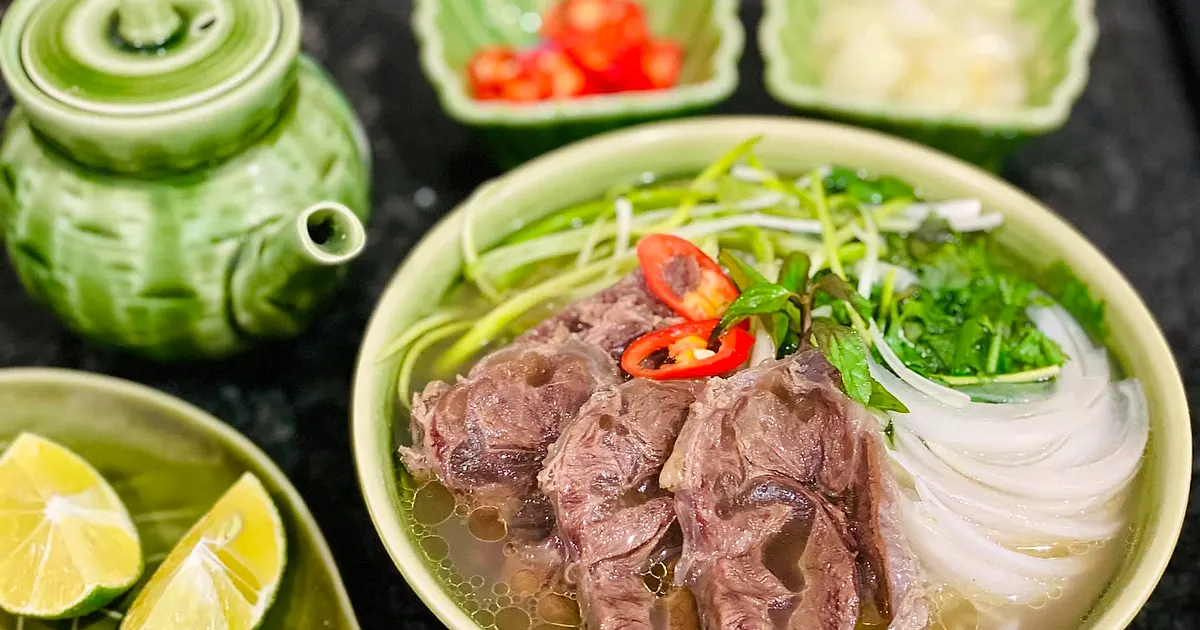
The broth, the garnish and who does the final seasoning. In Hanoi the bowl comes complete: a pale amber liquid you can see the bottom of, flat white noodles, thin slices of beef either cooked through or just scalded by the ladle, a scatter of spring onion and a little raw white onion. On the table there may be a jar of garlic cloves steeping in vinegar, a dish of sliced chilli, a quarter of lime. That is the whole arsenal. Many Hanoi shops also keep a basket of quẩy — lengths of fried dough — to tear and drop in, where they go soft and carry broth.
Order the same dish in District 3 and a second plate lands beside it: bean sprouts, Thai basil, sawtooth coriander, lime, bird's eye chilli. Two squeeze bottles stand within reach, dark hoisin and red chilli sauce. The broth underneath is deeper in colour and sweeter, often from rock sugar and sometimes from daikon or dried seafood in the stock. The portion is larger. The noodles tend to be finer. You are expected to build the bowl yourself, which is precisely what a northern cook would consider a failure of the kitchen.
Neither side is shy about this. A Hanoi vendor will tell you that herbs mask a weak stock. A Saigon vendor will tell you the northern bowl is thin. They are describing the same dish, roughly seventy years apart in its travels.
What happened in 1954?
Phở went south with the people who ate it. The Geneva Accords of 1954 split Vietnam at the seventeenth parallel and set off a migration of around a million northerners — Catholic communities in large numbers among them — to the south over the following months. They arrived into Saigon and the towns around it with trades, dialect, church calendars and recipes, and opened shops.
The dish had been northern before that. It took shape in and around Hanoi and the Nam Định area in the early twentieth century, in a landscape where beef was becoming available in quantity and rice noodles were already everywhere. What the migrants carried south was that bowl, more or less intact.
Then the south went to work on it. Herbs grow fast and cheap in the Mekong's climate, and southern cooking has a long tolerance for sweetness — coconut, palm sugar, rock sugar appear across the delta kitchen. Within a generation the bowl had acquired its garnish plate and its sweeter stock. The Chinese-Vietnamese commercial kitchens of Chợ Lớn are usually credited with the hoisin and chilli bottles. By the time the two halves of the country were administratively one again in 1976, phở was two dishes with one name, and the northern bowl still had no basil in it.
How should you eat each one?
Early, standing a little hunched over a low metal table, and without a camera for the first minute. Phở is breakfast at both ends of the country; the good shops start before six and the broth is at its best in the first two or three hours. A pot is a finite thing. Hanoi shops with a following will stop serving by mid-morning because there is nothing left, and the sign comes down until the next day's stock has simmered overnight.
In Hanoi, taste the broth before you touch the chilli. If the shop keeps the vinegared garlic, use one clove and a little of the liquid — it cuts the fat without flattening anything. In Saigon, go gently with the hoisin. It is not a mistake to use it; it is a mistake to pour it in before you have found out what the broth tastes like on its own. Tear the herbs rather than dropping whole stems, add the sprouts in small handfuls so they keep their snap, and squeeze the lime last.
If you want to understand why the two versions are described so differently in Vietnamese, the grammar of the menu is worth an hour — dish names here work more like instructions than descriptions, which we wrote about in a short piece on four cooking verbs. Travellers who want both bowls in one trip usually end up travelling the length of the country, which is the only way to taste the difference rather than read about it.
When this isn't for you
If you do not eat beef, the comparison narrows considerably — phở gà exists in both cities and is excellent in Hanoi, but the southern-versus-northern argument is mostly an argument about beef stock. If you need a clean, controlled kitchen environment, the best bowls are often served from a tiled front room with a pot on the pavement, and that will not suit everyone.
You also do not need a guide for this. Phở is the easiest meal in Vietnam to find alone: point, sit, eat, pay. Where a guide earns their place is in the stall two lanes off the main street that serves one thing and has done since the 1970s — but a traveller willing to eat where the motorbikes are parked three deep will find most of it unaided.
The sharpest way to feel the split is to eat phở on consecutive mornings at either end of the country. The same name, the same noodle, and a plate of herbs that marks a border nobody has been able to see since 1976.
Quick questions
Is it rude to add hoisin sauce to phở?
Not in the south, where the bottles are on the table for exactly that purpose. In Hanoi there is usually no hoisin to add, and asking for it will get you a patient look.
Does phở change with the seasons?
The dish does not, but your appetite will. It is most welcome in Hanoi's damp, drizzly cold from January to March, and a pleasure in the dry, clear autumn from October to December. Through the heat of April to September, and all year in the south, most people eat it early and sweat through it cheerfully.
Which city has better phở?
Hanoi if you want the broth to speak alone, Saigon if you like assembling your own bowl. Most Vietnamese will answer according to where their family lived in 1954.