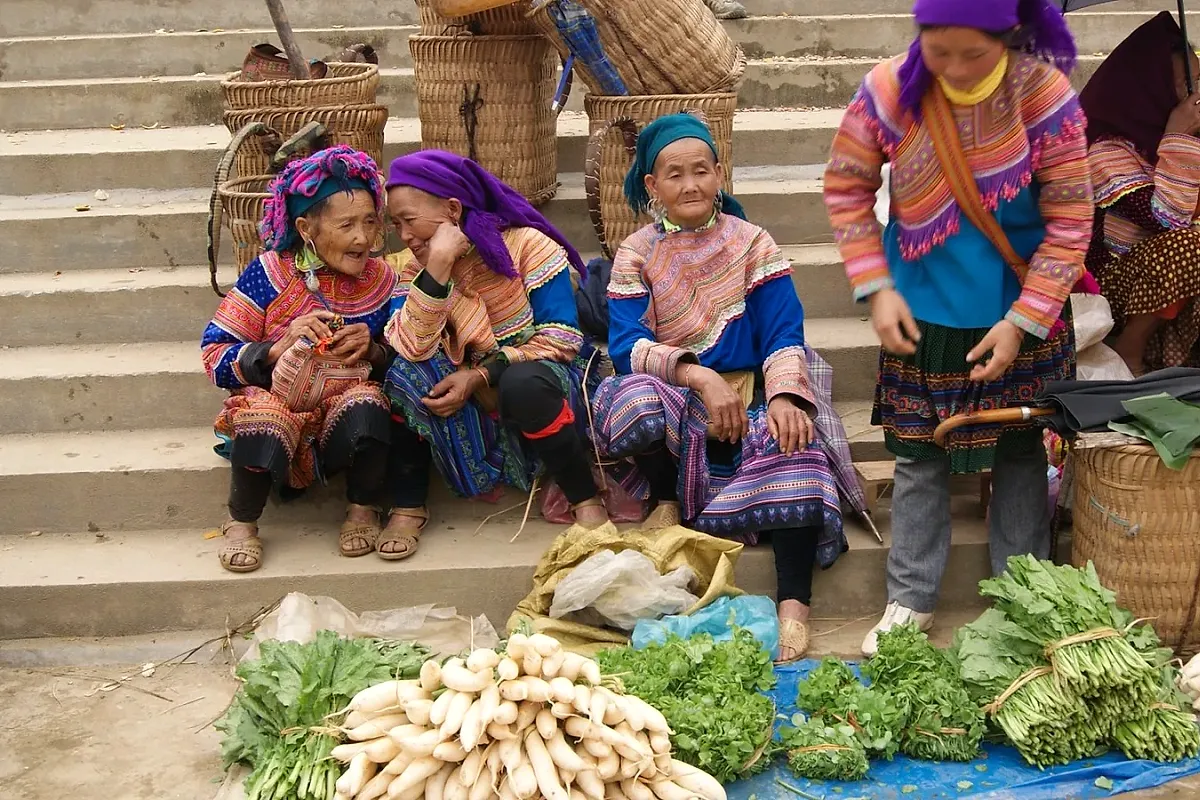
You will notice the hands before anything else. On the path above Lao Chải, at the hour when the mist is still lying in the folds of the valley like something spilled, our guide reaches back to steady you over a wet stone and her fingers are blue. Not a tint. A deep, saturated blue that has gone into the creases of the knuckles and under the nails and stopped just short of the wrist, where the sleeve ends. It does not wash off between October and March. It is not meant to.
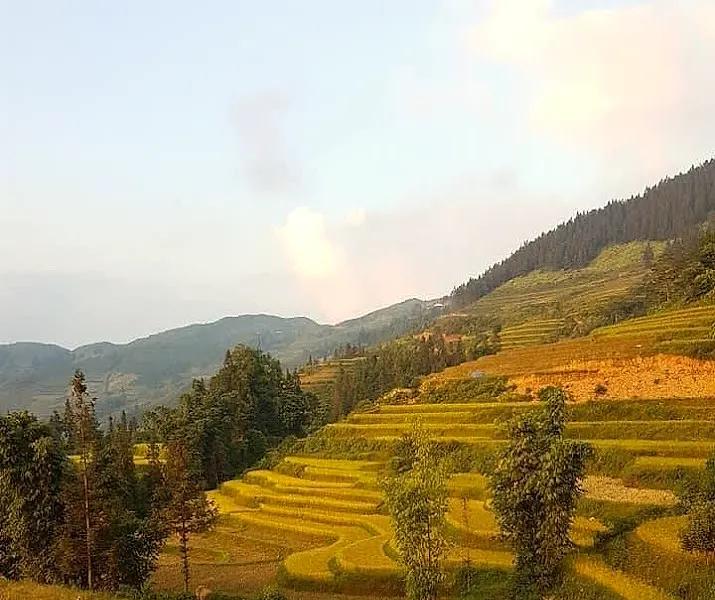
Most people come to the Muong Hoa Valley for the terraces, and the terraces deserve it. But the thing that will stay with you longest is not the geometry of the water. It is the cloth, and the fact that the woman walking ahead of you made it from a plant she cut herself.
A year, from seed to skirt
Hemp goes into the ground in spring, in the awkward corners the rice cannot use — the steep upper edges, the strips beside the graves. It comes out in July, tall and pale. The stalks are dried against house walls, then stripped, and the fibre is spliced by hand into a continuous thread, each end twisted into the next with a roll against the thigh. Women do this while walking. You will pass someone on a ridge path with a bundle of hemp under one arm and a spindle turning at her hip, and she will not break stride to do it.
The thread is boiled with wood ash to soften it, then beaten with a stone roller — a heavy curved block the worker balances on with both feet, rocking, until the fibre goes from stiff to something closer to linen. Then it is woven on a backstrap loom into a narrow bolt, perhaps forty centimetres across. Every seam you see in a Black H'Mong skirt exists because the loom is the width of a woman's shoulders.
Only then does the pattern go on, and only on some pieces. Molten beeswax is drawn onto the cloth with a nàng, a small copper-tipped pen with a bamboo handle, held at an angle so the wax runs in a line no wider than a pencil mark. The motifs are spirals, hooked crosses, rows of small stepped triangles. Nobody draws from a template. The pattern is learned from a mother the way a language is learned, by being in the room while it happens.
What the vat smells like
The indigo itself grows near the streams — a low, unremarkable shrub. Leaves are steeped in water until they rot, the sediment collected and mixed with lime and ash-water in a wooden vat kept beside the house, out of the wind. A living vat has to be fed and watched. It goes off if it is neglected, and there is no reviving it once it has turned.
The smell is the part no photograph carries: sharp, vegetal, slightly rotten, a little like a compost heap after rain, with something mineral underneath. When the cloth comes out it is green. It turns blue in the air, in front of you, over about a minute — the oxygen does the work. Then it goes back in. Eight dips, ten, twelve, over weeks, each one hung to dry, each one a shade closer to that near-black.
The finished cloth is beaten again with the stone roller until it takes on a hard, metallic sheen, like the inside of a mussel shell. That sheen is the mark of a good piece. On a bright day in the valley, a woman crossing a terrace bund catches the light and flashes.
Why we walk with her and not past her
There is a version of this trip where you photograph all of this from three metres away and understand none of it. It is the version that arrives by minibus at ten in the morning, walks a paved section of the Lao Chải path, buys something, and leaves before lunch.
Ours runs differently for one structural reason: the group is small, and the person leading is Black H'Mong and grew up in this valley. She is not interpreting a culture. She is describing a household — hers, or one two ridges over. When you stop at a house it is because there is a reason to stop, and because someone is in, and because the vat is working. The conversation happens in H'Mong first and reaches you second, which is the right order.
Ask her about the wax pen. Ask why the pattern on a girl's collar differs from the one on her mother's. Ask what happens to the vat in a cold February. You will get answers with hesitations and corrections in them, which is what a true answer sounds like.
Two practical honesties. The dye work is seasonal and domestic — hemp is cut in summer, the dipping runs through the cooler months, and no household stages it for visitors. Some days you will see a vat in full use, some days only the cloth drying on a rail. And the paths are clay. After heavy rain the upper route above Hầu Thào becomes unwalkable and we take the lower one, which is a fair trade for arriving intact.
The blue on her hands will fade around April, when the vats rest. By July there will be hemp drying against the wall again, and the whole thing starts over, exactly as long as it has ever taken.