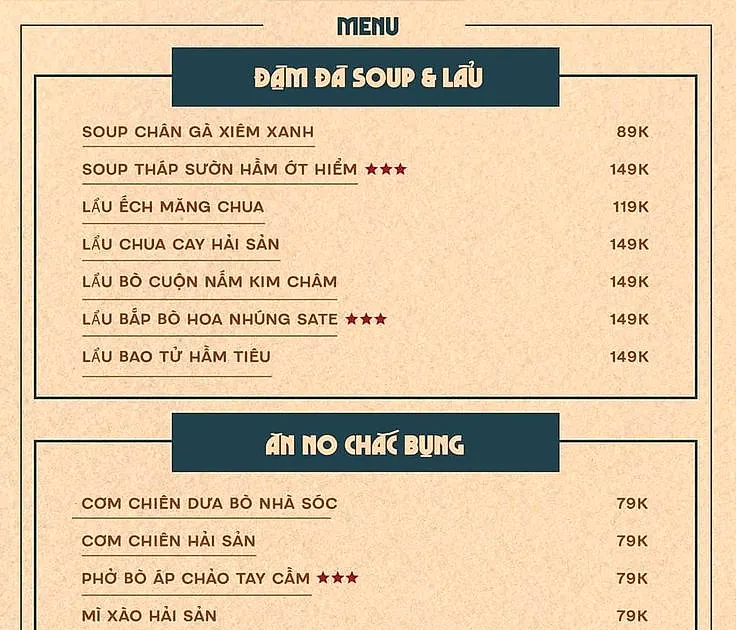
There is a quán on a corner in Hai Bà Trưng district with no menu on the table and no photographs anywhere. What it has is a sheet of A4 taped to the fridge, filled in by hand each morning in blue biro, six or seven lines long. Rau muống xào tỏi. Thịt heo luộc. Cá rô rán. Canh chua. Đậu phụ tẩm hành. Nothing on it is translated and nothing needs to be, once you know that a Vietnamese dish name is not a description. It is an instruction. Ingredient, then method, then whatever went in with it.
That order is the whole trick. English builds dish names around adjectives and place names — Tuscan this, pan-seared that — and leaves you guessing about the plate. Vietnamese tells you the ingredient and the heat that was applied to it, in that sequence, almost every time. The consequence is practical. You do not need vocabulary in the hundreds. You need about four verbs, a dozen nouns and a habit of reading left to right.
The four verbs that do most of the work
Luộc — boiled, or more accurately blanched in salted water and served plain, warm rather than hot, with a dipping sauce doing the seasoning. Thịt heo luộc is pork belly poached and sliced thin, eaten with shrimp paste in the north or a fish-sauce dip further south. Rau luộc is whatever green the kitchen bought that morning, dropped into water for ninety seconds. Luộc is the least decorated cooking in Vietnam and the hardest to hide behind: the ingredient has to be good. The water it was cooked in usually arrives as a side bowl, slightly sweet, and you drink it.
Nướng — grilled, almost always over charcoal, almost always marinated first. This is the word that produces smoke in the street at five in the afternoon. Gà nướng muối ớt, chicken with salt and chilli. Sườn nướng, the pork chop that sits on broken rice at a cơm tấm counter. Nem nướng, grilled pork paste on skewers. If a dish carries nướng and the table has a small clay brazier set into it, you are cooking your own dinner, which is the intention.
Xào — stir-fried fast in a little fat, and the most reliable thing to order when you are unsure. Xào is where the vegetables live. Rau muống xào tỏi is water spinach with garlic and possibly the single most-ordered dish in the country. Mực xào sả ớt is squid with lemongrass and chilli. Add xào không and you have asked for it plain, without the garlic — useful, and a phrase that surprises people when you use it.
Hấp — steamed, which in Vietnamese kitchens means aromatic rather than austere. Tôm hấp bia, prawns steamed over beer. Cá hấp gừng hành, whole fish with ginger and spring onion. Ngao hấp sả, clams over lemongrass, the broth in the bottom of the dish being the point of the exercise.
Then a second tier you will meet within a day. Rán in the north and chiên in the south, both meaning fried in deeper fat. Rang, dry-fried in a pan until the sauce clings — cơm rang is fried rice, thịt rang is pork cooked down hard. Kho, braised slowly in fish sauce and caramel until the liquid is nearly gone, sweet-salty and dark; cá kho tộ is the southern version, and tộ is not a flavour but the small unglazed clay pot it is cooked and served in. Cuốn, rolled. Trộn, tossed. Lẩu, hotpot, which means a burner on your table and a forty-minute meal rather than a ten-minute one.
The tail end of the name
Whatever follows the verb is the aromatic, and it is worth knowing five or six. Tỏi garlic, sả lemongrass, ớt chilli, gừng ginger, nghệ turmeric, lá chanh lime leaf, me tamarind, mỡ hành scallion oil, muối ớt salt and chilli. Put it together and gà nướng lá chanh resolves cleanly into charcoal-grilled chicken with lime leaf, before anything reaches the table.
A name with no verb in it is usually a composite dish with its own identity — phở, bún bò Huế, mì Quảng, bánh xèo, cơm hến. These are not built from a method. They are named things with fixed forms, and the noodle word at the front tells you the shape of what is in the bowl: phở flat rice noodle, bún round rice noodle, mì wheat, hủ tiếu a firmer southern rice noodle, cơm rice.
The vocabulary moves as you move
Travel the length of the country and the words shift under you. A cold shredded salad is nộm in Hanoi and gỏi in Saigon. Fried is rán in the north, chiên in the south. Pork is thịt lợn above roughly the Hải Vân pass and thịt heo below it. In Huế, expect ruốc and mắm tôm chua attached to things, and expect chilli to be assumed rather than offered. In the delta, kho arrives sweeter, because the caramel is heavier and the sugar is local.
There are two more phrases that earn their keep. Ăn chay, vegetarian, which in Vietnam usually means Buddhist vegetarian and excludes fish sauce. And không cho ớt, no chilli, said at the point of ordering rather than after the bowl lands.
None of this makes you fluent. What it does is remove the pointing. You read the fridge door, you find the verb, and you order a dish you have never eaten in a place that has never served a foreigner lunch — which is, in the end, most of the good places.