The pan is about a metre across, black, shallow, sitting on three stones over a wood fire that was lit before dawn. Inside it, something has been moving at a slow simmer for hours: bone, offal, thick cuts of meat, a broth the colour of wet earth with sprigs of lemongrass surfacing and sinking. The woman tending it does not stir so much as fold. She lifts, turns, lets it fall back. Around the fire are plastic stools and two long benches of unplaned wood, and by half past eight every one of them is taken.
This is the eating corner of Bắc Hà market, uphill from the fabric stalls, downwind of the livestock pens. Most visitors walk past it toward the embroidery. That is a mistake, and it is the reason we build the third morning of the Sa Pa journey around arriving here early rather than late.
What is actually in the pan
The dish is thắng cố, and it is H'mông. The name has been explained to me three different ways by three different people in the same market, which is usually a sign that a word is genuinely old. What is not in dispute is the method: a whole animal, cooked down over many hours in a single wide vessel, nothing discarded.
Traditionally the animal is a horse. In practice, at Bắc Hà on a given Sunday, you will find pans of horse, buffalo and beef within twenty paces of each other, and the vendor will tell you which is which if you ask. The seasoning is where the dish stops being simply a stew. Thảo quả — black cardamom, grown in the high forest around Bát Xát and Mường Khương, and one of the few cash crops that does well above a thousand metres — goes in whole, split at the seam. So does mắc khén, the northern mountain pepper that numbs rather than burns. Then lemongrass, ginger, star anise, a handful of things the cook will describe collectively as lá rừng, forest leaves, and decline to itemise.
It is ladled into a plastic bowl with a lot of broth and not much ceremony. Eat it hot. It is rich in a way that asks for something sharp alongside, and that is what the second half of this corner exists to supply.
Bản Phố, and the reason for the jerrycan
On the ground beside almost every bench is a twenty-litre plastic jerrycan and a stack of small glasses. The wine inside comes from Bản Phố, a commune of H'mông hamlets on the ridge a few kilometres from the market, and it is made from corn — the hard, flinty local corn grown on the slopes, not sweetcorn.
The part that matters is the leaven. Bản Phố distillers use a starter made from the seed of hồng mi, a millet-like plant they grow specifically for this purpose, ground and formed into cakes that are dried in the roof smoke of the house. Rice-wine leaven is bought at market; this one is made at home, and each family's is slightly different. The corn is boiled, cooled on a mat, mixed with the crushed leaven, left to ferment in wooden tubs, then distilled over a wood fire using spring water from the ridge as the condenser coolant. Distillers in Bản Phố will tell you the water is the reason the wine tastes the way it does, and they will name the spring.
It comes out clear, warm rather than harsh, faintly sweet at the back. Sellers pour a measure into a glass and hand it across without being asked. Refusing is fine. Accepting is better, and it changes the tone of the next ten minutes considerably.
An hour that has a shape
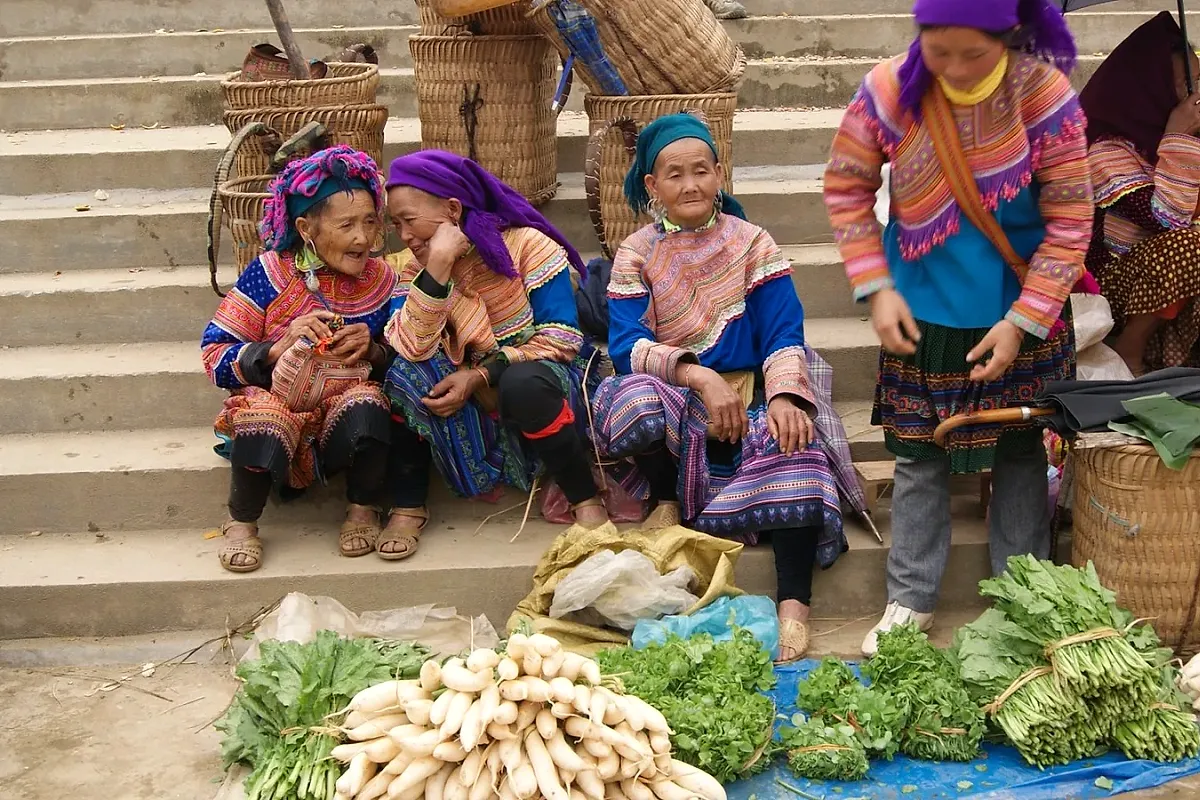
Bắc Hà happens once a week and only on Sunday. The Flower H'mông women come down from the surrounding hamlets in skirts of layered machine-embroidered panels — pink, orange, magenta, a palette that has nothing to do with any other H'mông group in the north — and Phu Lá and Tày and Nùng families come in from further out. The buffalo and horse pens sit at the top of the slope, and that trade is the reason many of them made the walk.
The rhythm is worth knowing before you arrive. From seven, the animals move and the wholesale business is done. By eight the fires are properly going. Between half past eight and ten, the market is at full pressure and the eating corner is loudest, because business concluded is business drunk to. After eleven, families begin the walk home, coaches from Sa Pa and Lào Cai start arriving in numbers, and what is left is mostly textiles for visitors.
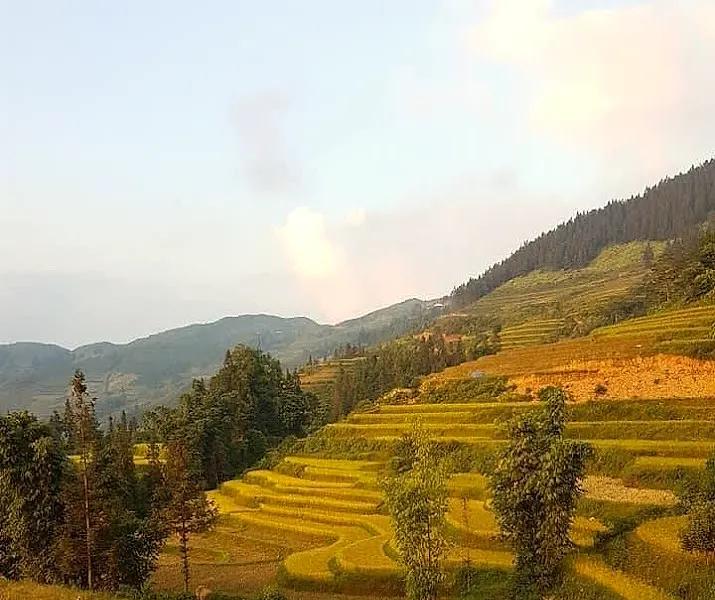
So we leave Sa Pa early. It is roughly two and a half to three hours northeast, dropping off the Hoàng Liên range, crossing the Chảy river, then climbing again onto the Bắc Hà plateau at around nine hundred metres, through plum orchards that go white in February. The point of the early start is not efficiency. It is to be sitting on a wooden bench with a bowl in both hands during the hour when the market is doing its actual work, rather than photographing its aftermath.
You will smell the smoke on your clothes for the rest of the drive back to Hanoi. That is not a complaint. It is black cardamom and pine, and it lasts about as long as the drive does.