Short answer: Because legs are stronger than arms over two hours, and a rower facing forward with the oars under their feet can see the channel, steer and keep their hands free. It is a working technique, not a show for visitors. Whether it stays with you depends on whether you sit forward and watch the feet rather than the cliffs.
Why do rowers in Tam Cốc use their feet?
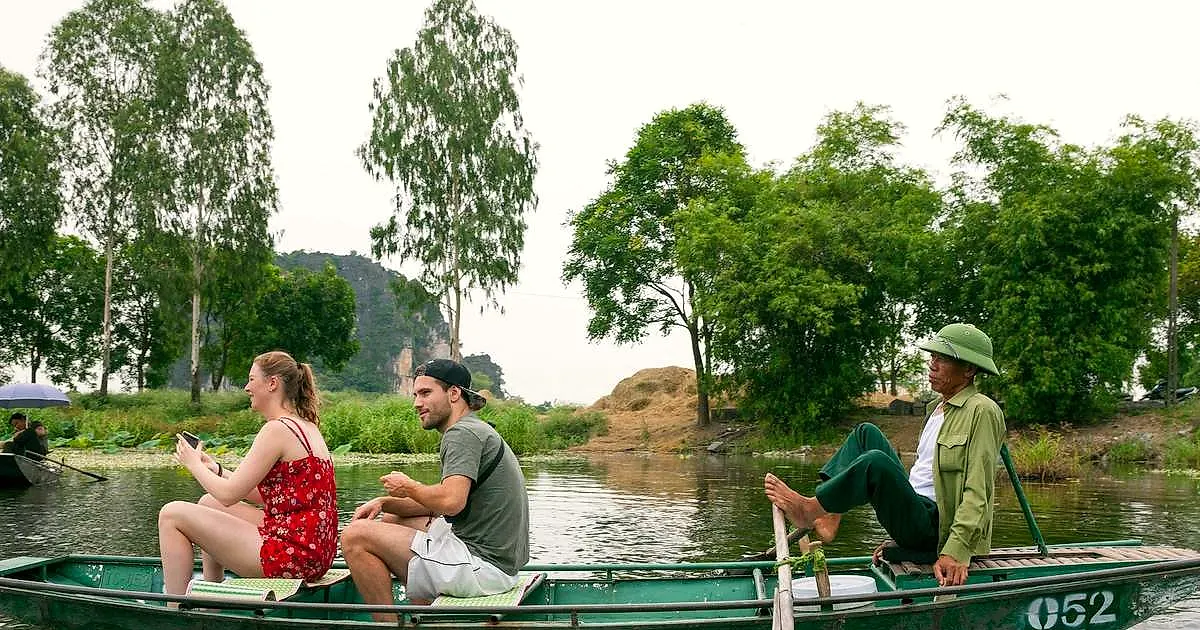
Because the trip is long, the boat is narrow and the shoulders give out before the legs do. The sampan on the Ngô Đồng is a shallow flat-bottomed metal or wooden hull, barely wider than the two passengers sitting in it, and the return journey takes the better part of two hours against and with a slow current. A rower sitting on the stern thwart with an oar loom tucked across each instep uses the big muscles of the thigh and calf, in a slow bicycle motion, the heels doing the pull and the toes the feather. Hands rest on the gunwale or in the lap. Some rowers switch to arms in the tight turns and go back to feet on the open stretches.
Watch for a minute and the rhythm reveals itself: the oars never leave the water fully, so there is no splash and almost no sound beyond a soft knock against the tholepin. The river is clear enough in the dry months to see the weed lying flat along the bottom, combed in the direction of the flow. Ducks move off the bank in a line. Somewhere behind you a second boat is doing exactly the same thing with nobody talking.
What are the three caves actually like inside?
They are low, dark, cool and short — Tam Cốc means three caves, and the boat passes through all three before turning. Hang Cả is the longest; Hang Hai and Hang Ba follow upriver. The ceiling drops without much warning and the rower will say something or tap the hull, which is your instruction to sit down properly and keep your hands inside the boat. In places there is enough headroom to sit upright and in places there is not.
The temperature changes the moment the daylight goes. Limestone holds cold, and water running under it holds more, so the air inside is noticeably cooler than the river outside — and the moment you come out the far side, the sun is on your neck again. That is the honest version: cool for two or three minutes at a time, exposed for the rest. Bring a hat you can keep on in wind, because the open stretches between caves have no shade at all.
The rock above the entrances is wet and streaked dark, hung with small ferns, and the stalactites near the mouths are smoke-coloured from the river's reflected light rather than from any lamp. There is no lighting installed. What you see is whatever the opening lets in.
What else is worth noticing from the boat?
The fields. The Ngô Đồng cuts straight through working rice paddy, so the banks are not scenery but somebody's plot, with the karst standing up behind them like furniture pushed against a wall. Cutting is usually done by hand; you may see a woman in the water to mid-calf, bent, with the cut stems bundled on the bank behind her.
The rowers themselves come from the villages along the river, Văn Lâm among them, a place better known for hand embroidery than for boats. Many households have a rotation, and a family may row only a handful of times a month. If your rower has an embroidered cloth folded on the thwart, that is where it was made.
A private seven-day trip through Hanoi, Ninh Bình and Hạ Long Bay puts a private sampan through the three caves on the same day as cycling through the Tam Cốc rice fields, with the old capital at Hoa Lư earlier and the Mua Cave ascent — around 500 steps, roughly 98 metres above the valley floor — after 3:30pm. That is the suggested shape of the day and it can be rearranged; in the hottest months, pulling the water earlier and the climb later is the sensible instinct.
When is the water worth seeing?
October to December is the north's clearest and mildest stretch, and the light on the river is at its best then. January to March brings cool grey days and fine drizzle, and Ninh Bình is often misty — atmospheric from a boat, poor for photographs. The rice in the Tam Cốc fields is green through spring and turns gold around late May into early June, which is the most photographed moment of the year here and also one of the hottest; go early. June to September is humid with sudden afternoon thunderstorms, which can arrive while you are an hour from the landing with no cover.
When this isn't for you
If you cannot sit still and low for close to two hours, skip it. The seating is a plank, there is no backrest, you cannot stand up, and once you have left the pier there is no way to shorten the trip. Anyone with a bad back, a recent hip or knee operation, or genuine claustrophobia in low dark spaces should consider the land route instead — the cycling through the same fields reaches much of the same view with your own legs and your own timing.
If you have already taken a boat at Tràng An, you have seen longer caves and more of them. Tam Cốc's case rests on the fields and the rowing technique, not on the caves. And if your idea of a river hour is solitude, know that this is a popular stretch of water, and your boat will be one of many moving in both directions.
The technique is the thing that stays. Not the karst — you will see better karst in the bay two days later — but a person sitting with their back straight, feet turning slowly in the air, taking you four kilometres upriver without once using their hands.
Quick questions
How long does the Tam Cốc boat trip take?
Roughly two hours return, plus whatever wait there is at the pier. It cannot be cut short once you are on the water.
Is it cool on the river?
Only inside the caves, which take a few minutes each. The open stretches are fully exposed, so bring a hat and sun cover.
Should I bring small notes?
Yes. Tipping the rower is customary rather than required, and vendor boats sometimes meet passengers near the turning point.