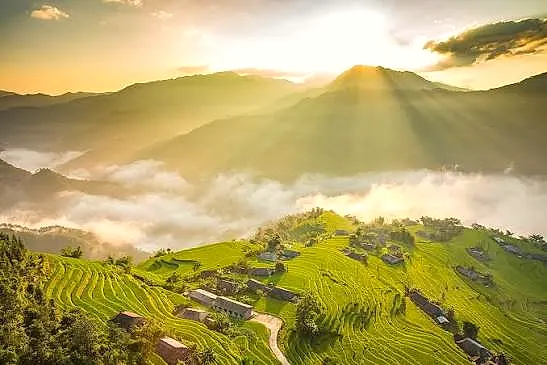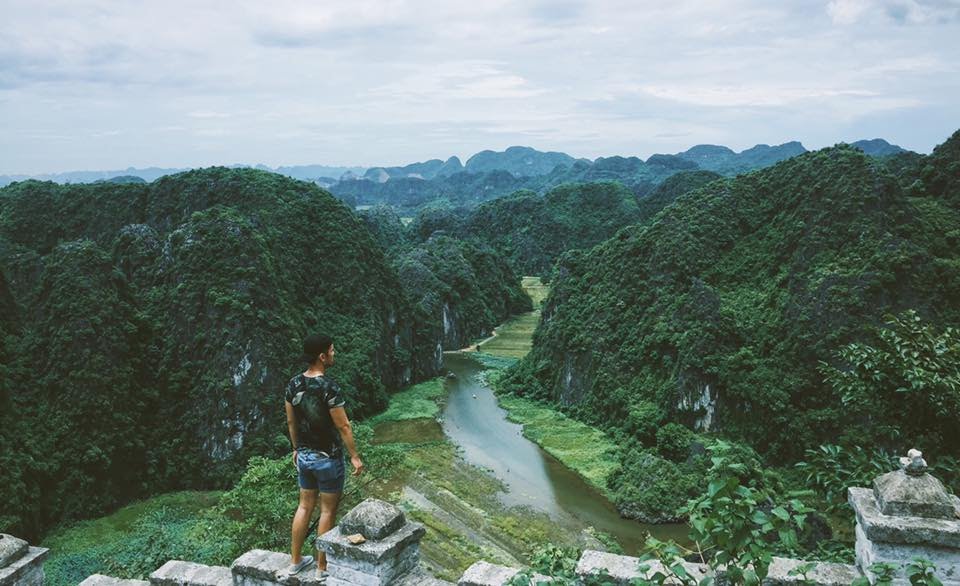
The first thing to understand about Hoa Lư is that nobody built the walls. They were already there — grey limestone rising two hundred metres straight out of the rice, so sheer that the engineers only had to fill the gaps between them with earth ramparts. Where a river ran through, they left it. The water became the gate. From the air the whole arrangement reads as a single irregular room, roughly three hundred hectares, with mountains for sides.
Đinh Bộ Lĩnh chose it in 968. He had spent his childhood in these valleys herding buffalo, and the stories the local guides still tell — mock battles fought under reed flowers for banners, cờ lau, the boy carried on crossed hands as a throne — are almost certainly later embroidery on a real fact: he knew the ground. Whether or not the reed flags happened, they tell you what people wanted their first emperor to be: local, poor, and good at organising. He had just finished subduing twelve warlords who had carved up the north after the Chinese withdrawal, and he needed a capital that a returning army could not take. He declared himself Đinh Tiên Hoàng, called the country Đại Cồ Việt, and put its government inside a natural fortress rather than on a river plain where trade would find it.
It lasted forty-two years. That is the whole span: two dynasties, five rulers, one assassination in 979 — Đinh Tiên Hoàng and his eldest son, killed in their own palace — one Song invasion turned back by his general Lê Hoàn, who had taken the throne the following year, and then a letter.
What survives, and where to stand
There is no palace. The timber went, as timber does in this climate, and the seventeenth-century temples that stand on the site today sit on the old foundations rather than preserving them. The court left in 1010; the masons kept coming back. This disappoints people who arrive expecting Angkor. It shouldn't. The two temples — one to Đinh Tiên Hoàng, one to Lê Đại Hành, facing each other across a few hundred metres of flat ground — are among the finest carved wooden buildings in the north: ironwood columns resting on carved stone drums so the damp cannot climb, roof beams black with four centuries of incense. The reason to go early is that at half past eight the light comes in low through the front doors and lands on the stonework.
In front of the Đinh Tiên Hoàng temple lies the long sàng, a dragon couch cut from a single block of stone and carved with dragons whose bodies are broad and blunt in a way that later Vietnamese dragons never are. It has been recognised as a national treasure. Look at the dragon's forefoot: it grips its own beard. Nobody has satisfactorily explained the gesture. Our guides will tell you the competing theories and then tell you which ones they don't believe.
Behind the temples, a stairway climbs Mã Yên — Saddle Mountain — to Đinh Tiên Hoàng's tomb. It is a short, steep, unglamorous climb, usually empty, and from the top the logic of the whole site becomes visible in about four seconds. You can see every gap in the ring of karst, and you can see that there are very few. Below you, the two temple roofs look very small on a floor that, according to the annals, once held a palace with gilded pillars and a courtyard where the emperor kept a caged tiger and a cauldron for anyone who broke his laws.
The letter
In 1010 Lý Công Uẩn, newly enthroned, wrote the Chiếu dời đô, the Edict on the Transfer of the Capital. It is a short document and unusually candid for a royal proclamation. He argues, in effect, that his predecessors stayed in Hoa Lư out of fear. The valley was chosen for defence, and defence is what a weak state needs; a confident one needs a river, a plain, and room for markets. He describes Đại La — the site he was moving to, which he renamed Thăng Long, Rising Dragon, and which is now Hanoi — as flat, open, well-watered, and suited to ten thousand generations.
It is the earliest surviving piece of Vietnamese political writing that reads like a decision rather than a decree. And it means that Hoa Lư was not sacked or lost. It was outgrown. The mountains that had kept the kingdom alive for forty-two years had become the thing preventing it from growing, and someone said so out loud in writing.
Hold that in mind for the rest of the day. The Tam Cốc rice fields you cycle through in the afternoon sit inside the same ring. The sampan that takes you through the river caves passes under limestone that once functioned as a curtain wall. And when you climb to the viewpoint above the valley late in the day — the long stair, the temperature finally dropping, the Ngô Đồng river below turning the colour of tea — you are standing where the strategic argument becomes obvious. Everything Lý Công Uẩn complained about is laid out in front of you: beautiful, enclosed, and too small for a country.
A note on the hour
Hoa Lư gets coach groups. They arrive between ten and half past, do both temples in forty minutes, and leave. Before ten the courtyards are quiet enough to hear the caretaker sweeping, and the incense from the morning offering is still hanging in the inner chamber. The tomb on Mã Yên is almost never busy at any hour, because it involves steps and most itineraries do not allow the time.
The site is not fragile in the way a cave system is. What is limited is the good hour, and the good hour is narrow at both ends: too early and the temples are still shut, too late and you are sharing a small dark room with fifty people. Getting it right requires leaving Hanoi before most breakfast rooms open, with something to eat in the car. That is the entire trick, and it is worth the alarm.
Once a year, in the third lunar month, the village holds the Hoa Lư festival: a water procession on the Hoàng Long river, and children carrying reed flags across the field where the buffalo boy is supposed to have drilled his army. The rest of the year it is a lane, two temples, and a stone couch nobody is allowed to sleep on.