At five in the morning, the valley does not yet exist. There is only sound — a rooster two ridges away, water moving through a bamboo channel, the low cough of a water buffalo somewhere below the fog line. Then, without ceremony, the sun clears the eastern ridge and the terraces of Hoàng Su Phì appear one contour at a time, gold rice catching the light in bands that curve around the mountainside like a topographic map made visible.
This is Hà Giang province, four hours north of the terraces everyone has already photographed. Sa Pa ripens in September and fills with buses. Hoàng Su Phì ripens two to three weeks earlier, and almost no Western traveler has ever stood in it.
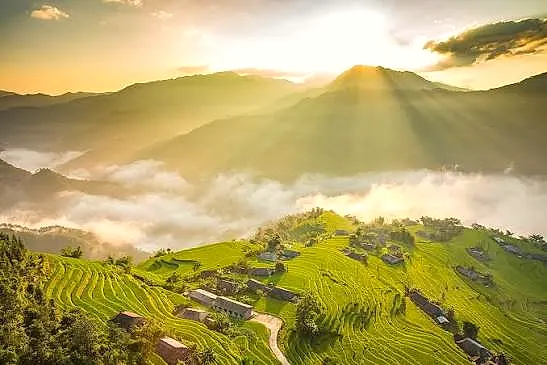
First light over the Hoàng Su Phì terraces — the valley before the crowds ever arrive.
A Landscape Timed by Hand, Not by Calendar
The terraces here are not decorative. They are working infrastructure, engineered over generations by Dao, Nùng, and La Chí families who read the mountain the way a sommelier reads a vintage — by elevation, by water source, by the angle a particular slope catches the sun. This is precisely why the ripening is not uniform. A field at 1,400 meters may turn gold ten days before its neighbor at 1,800.
Local Expert Note #1: Hoàng Su Phì has no single "peak week." The communes of Bản Luốc and Bản Phùng ripen first, typically in the last ten days of August; Hồ Thầu and Thông Nguyên follow roughly two weeks later. A generic booking made a month out is a guess. VAC works directly with a La Chí family guide who walks the fields weekly and confirms the ripening line by commune, not by province — which is the difference between arriving at gold and arriving at green.
The families who farm these slopes still do so largely without machinery. Watching a harvest here is watching a system: the cutting, the threshing done by hand against a woven basket, the drying laid out on tarps along the roadside where the mountain flattens for a hundred meters before dropping away again. There is no performance in it. No one has been asked to wear anything for a photograph.

The harvest, up close — a moment of labor rather than landscape.
Staying Inside the Rhythm, Not Beside It
A private homestay here is not a rustic gesture toward authenticity — it is the only way to actually see the harvest, because the best of it happens before most lodges have poured their first coffee. VAC arranges stays with a single H'Mông family in a wooden stilt house above Hồ Thầu, where the morning begins with the household's own routine, and guests are guided, not managed.
Local Expert Note #2: Etiquette matters more here than in almost any other part of northern Vietnam, precisely because so few outsiders visit. Do not photograph a family mid-harvest without asking first, even from a distance — a raised camera and a brief nod of the head is understood universally and is the correct approach. Stepping onto the low terrace walls themselves is considered disrespectful to the labor invested in them; guides will always indicate the correct path along the field edge.
Meals are taken with the family rather than served separately — usually a broth built from whatever came out of the garden that morning, sticky rice cooked in a bamboo tube over the outdoor fire, and, if the timing is right, a small dish of newly threshed rice roasted with black sesame, eaten within hours of leaving the stalk. It does not appear on any menu because it cannot be stored or transported. It exists only here, only now.

Dinner begins over open flame, not a stovetop — the household's evening routine, unstaged.
Local Expert Note #3: The photographic light here has two windows, not one. The obvious one is 6:00–7:15am, when low sun rakes across the terraces and mist still sits in the lower valley. The second, quieter window is 5:00–5:45pm, when the light turns amber rather than gold and the working day is ending — families walking home along the ridgelines with baskets on their backs, a far more human frame than the empty-landscape shot everyone already has.

The second light window — amber rather than gold, and far quieter.
The VAC Insider's Tip
Do not chase the terraces at the moment they are most photographed. Chase them ten days before that moment, when the color is still arriving rather than already peaking, and the roads are still quiet. VAC's local guide tracks the ripening commune by commune throughout August and will only confirm your exact travel window once the fields themselves are ready — not before.
Hoàng Su Phì rewards precision, not spontaneity. VAC Travel arranges private, guide-led access to this harvest — including family homestays, exact-timing advisory, and a dedicated vehicle and driver for the mountain roads — as part of our bespoke Hà Giang itineraries. For travel dates in late August, we recommend beginning the conversation with our team at least six weeks in advance.