Go early enough and the valley at Mỹ Sơn is still holding the night's damp. The path in runs under trees, the Khe Thẻ stream is low and brown, and the towers appear in the order they were meant to — not all at once from a car park, but one brick shoulder at a time through the leaves. Cicadas start around seven. Before that there is only water moving over stone and the sound of your own feet.
Stand close to any surviving tower and do the thing most visitors skip. Put your eye about ten centimetres from the wall and look for the line between two bricks.
You will struggle to find it.
The joint you cannot find
The Cham fired their bricks from local clay, then laid them so tightly that the seam is often thinner than a fingernail and, in places, invisible to the naked eye. There is no lime mortar. No sand. No visible bedding layer of any kind. The blocks appear to have been ground against one another until the two faces matched exactly, then bonded with a vegetable resin — the leading candidate is the sap of the dầu rái tree, a dipterocarp that still grows in the surrounding forest and whose resin was used for centuries to waterproof boats along this coast. Some researchers argue the walls were built first and fired afterwards, the whole tower turned into a kiln. Others say the resin theory alone accounts for it. Nobody has settled it.
The strongest evidence is not in any paper. It is in the twentieth-century repairs. Where restorers in the 1980s used cement to stabilise a collapsing wall, the cement has cracked, greyed and spalled while the original brick beside it stays sharp-edged and holds carved detail. You can run a thumb along a Cham pilaster and feel a lotus petal cut directly into the fired brick — carved after firing, into the assembled wall, not moulded and stuck on. Then move your thumb thirty centimetres left onto the modern patch and feel nothing but grit.
Later work has been more honest about the gap in knowledge. A long Italian–Vietnamese conservation programme at Group G, running through the 2000s, made new bricks from local clay to Cham dimensions, used an adhesive based on plant resin rather than cement, and left every intervention legibly different from the original so that no future visitor mistakes a repair for the eighth century. It is slower, less complete, and much more useful.
What the craters left
Group A held A1, a tower of about twenty-four metres that scholars considered the finest single structure the Cham built. It stood until 1969. A week of bombing during the war removed it, along with most of its group, and what remains is a low field of brick rubble, foundation courses and a scatter of sandstone lintels laid out on the grass. Two bomb craters nearby have filled with water and become ponds. There are still unexploded ordnance markers at the edges of the site; the cleared paths are cleared, and the uncleared ground is fenced, and that fencing is not decorative.
Of roughly seventy structures documented across the valley, only around twenty stand in any meaningful sense. The rest are ground plans, half-walls, a doorframe with nothing behind it. This is worth knowing before you arrive, because Mỹ Sơn photographs like a ruin and reads like an archive. The rewarding hour here is not the wide shot. It is the close one: a sandstone base carved with dancing figures, a drainage channel cut so that lustral water poured over a linga could run out through the tower's north wall, the tenon holes where a wooden door once hung.
The valley was in use for something like nine centuries, from the late fourth to the thirteenth, which makes it one of the longest continuously built religious sites in Southeast Asia. Kings came here to be consecrated. The mountain closing the southern end of the valley, Mahaparvata, was the point of the whole arrangement.
The same clay, six hundred years later
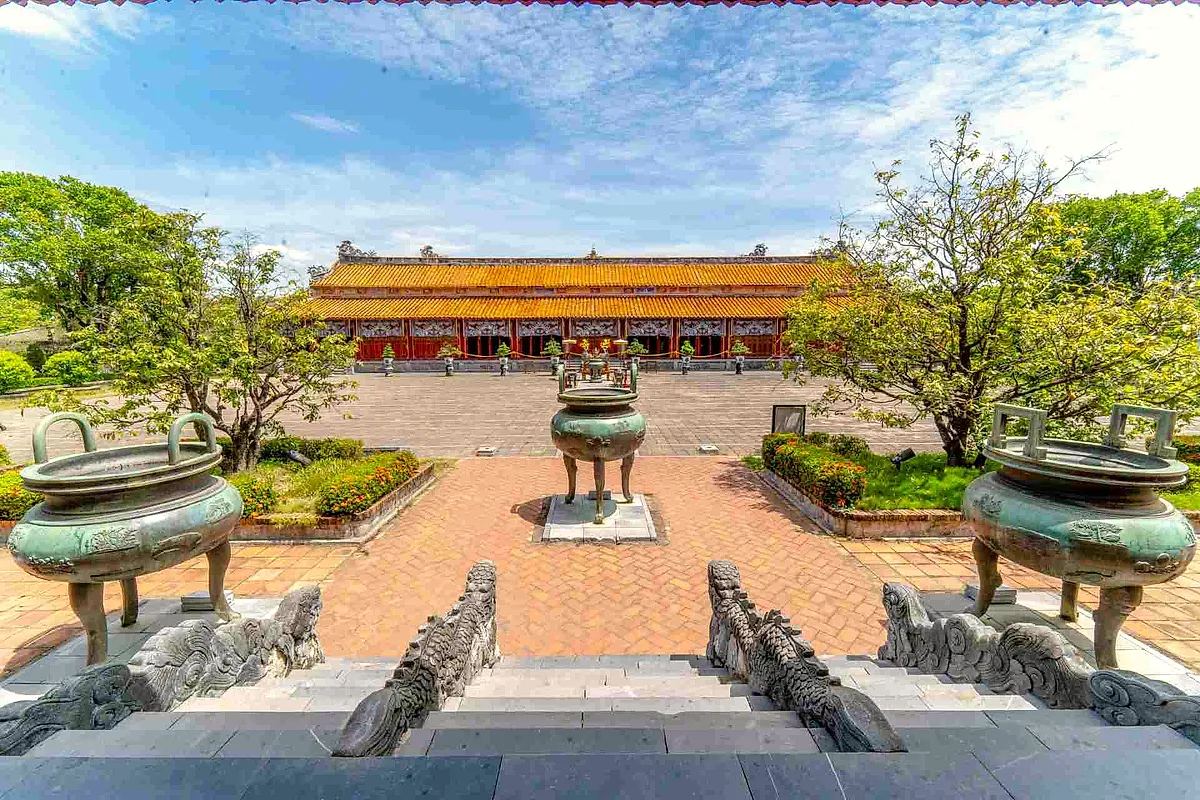
Carry the brick question east and it keeps paying. The Citadel at Huế is a Nguyễn work of the early nineteenth century, built to a European bastion plan, and its outer walls are brick faced over an enormous earth core — a completely different technology, mortar and all, and one designed to absorb cannon rather than resist rain. In the Ancient Town at Hội An the merchant houses use brick only where they must, for party walls and fire breaks, and give everything else to jackfruit wood, which moves with the humidity and can be dismantled and lifted above flood level.
Three answers to the same coast, the same monsoon, the same clay. Cham temple builders sought a wall that would never let water in. Nguyễn engineers wanted mass. Hội An's Chinese and Japanese traders wanted a house they could take apart. Once you have been shown the joint at Mỹ Sơn, you look at every wall in central Vietnam differently, and the region stops being a sequence of sites and becomes an argument between builders.
Our guides here trained on the archaeology rather than the script, and the questions they get asked at Group G are the ones they enjoy most — because the honest answer to how the Cham joined their bricks is still, after a hundred and thirty years of study, that we are not entirely sure.