Short answer: Yes, and not rarely. The Thu Bồn backs up most years in October and November, and the old town takes water — sometimes ankle-deep for an afternoon, occasionally waist-deep for days. Whether that spoils your trip depends entirely on what you came for. Beaches and island boats suffer badly. Food, houses, museums and an emptier town barely suffer at all.
How bad does the water actually get?
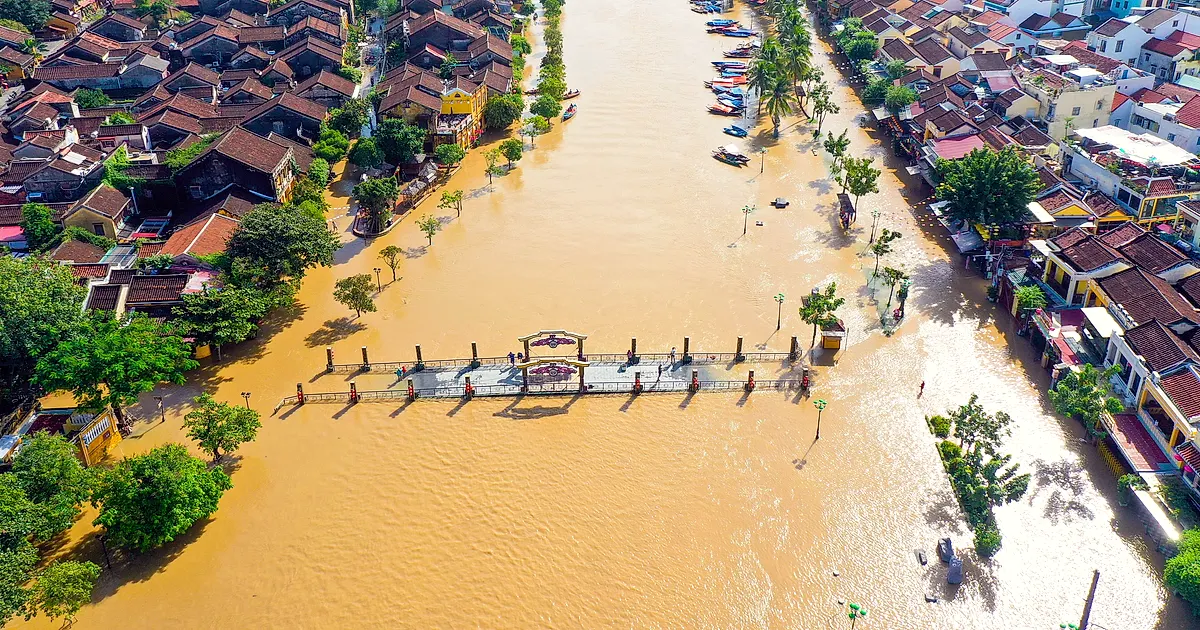
It ranges from a wet street to a street that is a canal, and both happen in the same season. The heaviest rain on the central coast falls in October and November, usually arriving in long grey sheets rather than the short afternoon bursts the south gets. When a storm system stalls over the mountains west of Hội An, the Thu Bồn carries that water down to a town built almost at sea level, where the river meets an incoming tide. The two meet on Bạch Đằng street first. That is the row of shophouses facing the water, and when locals say the river is coming they mean it quite literally: it comes up through the drains and across the quay within an hour or two.
The old merchant houses have been reading this for centuries. Inside several of them you can see a ladder of marks painted or carved on a wall — a record of the years the water reached a particular beam. The ones people point to are the great flood of 1964 and the flooding of 1999, both of which caused severe damage across the central provinces. Some of those houses also have a square hatch cut into the ceiling of the ground floor, with a pulley above it, so that a family could hoist furniture and stock to the upper storey before the river arrived. It is not a museum feature. It still gets used.
What does a flood day look like from the street?
Quieter than you would expect, and better organised. By the time the water is over the kerb on Nguyễn Thái Học, the ground-floor stock of most shops is already upstairs, chairs are stacked on tables, and someone is sitting on a doorstep in shorts watching the level with the detachment of a person who has done this thirty times. Motorbikes are parked on bridges and high ground. Café owners run a plank from the step to the dry side of the lane. Flat-bottomed boats appear, rowed down streets that were full of tailors the previous morning, and they are working transport as much as a curiosity — getting people to the market, carrying rice and gas bottles.
The smell changes. River silt, wet lime render, the particular dampness of two-hundred-year-old timber. Light goes flat and silver, which does unexpectedly flattering things to yellow walls. Lanterns still go on above the water, and the reflection on a flooded street is the version of that silk-and-bamboo trade that most visitors never see.
Then it drains. A one-day flood is often gone by the following afternoon, leaving a brown tideline on the walls and a town scrubbing its floors with brooms and hoses. Within forty-eight hours the tailors are back at their machines.
Why would anyone choose to come then?
Because the same weeks that bring the water take away the crowds, and because central Vietnam's indoor heritage is unaffected by rain. The old town in early November, between systems, is a different place from the old town in July: cool enough to walk at midday, no queue at the ticket booths, cafés with free tables, light that photographers prefer. Prices soften. Rooms open up.
Huế, two and a half to three hours north by road, is wet and cool from September deep into January, and its best material is weatherproof — the citadel's interiors, the bronze and timber, the tombs under dripping pines, which look considerably more convincing in mist than in hard sun. Mỹ Sơn in rain is muddy underfoot and almost deserted, and the brickwork darkens to a deep rust. A journey along the imperial and coastal route through this stretch of the country loses its beach days in the rainy months and gains almost everything else.
Food, too. This is the season for things eaten hot and sitting down: bún bò, mì Quảng with the broth barely covering the noodles, cao lầu, sweet ginger chè. Nobody in Hội An treats rain as a reason to close the kitchen.
How do you plan a central Vietnam trip in flood season?
Build the itinerary so that no single day is load-bearing. Practical judgement rather than a rule book:
- Keep two or three flexible days in the middle of the central leg rather than one tightly scheduled day per site. A flood is usually a two-day event, not a two-week one.
- Sleep outside the old town if you want certainty. Hotels toward An Bàng or on the Đà Nẵng side are generally less exposed to the river and stay reachable when the quay does not.
- Treat island trips to Cù Lao Chàm as optional. Sea conditions in this season frequently suspend the boats, and that decision is made by the port authority on the morning, not by anyone else.
- Pack for it: sandals you can rinse, a dry bag for a camera, a light rain shell rather than an umbrella, because wind on this coast makes umbrellas pointless.
- Check the forecast across a whole week, not a day. Systems here announce themselves several days out.
- Look at travel insurance terms before you book, particularly the wording about weather disruption. Worth reading in detail; our practical questions page covers the usual ground on planning.
When this isn't for you
If the beach is the point, do not come. An Bàng and Cửa Đại in October and November are grey, rough and sometimes closed to swimming, and the shoreline is actively eroding in places. If you have mobility limits, flooded streets with unseen kerbs and open drains are a genuine hazard, not an inconvenience. If your trip is short — four or five days on the central coast with a flight out on a fixed date — the odds of losing a meaningful share of it are too high to accept casually. Families with small children will find wading novel for an hour and tiresome after that. And if you want photographs of Hội An dry and lantern-lit at the golden hour with no complications, come in February or March instead, when the weather is mild and the light is reliable.
Those who do come in the wet weeks tend to describe the same thing afterwards: a town that keeps working while the river is in it, and a kind of competence that is invisible in the dry season.
Quick questions
Which months are the real flood risk?
October and November are the heaviest, with risk tailing into December. September is wet but floods less often, and Huế stays wet and cool into January.
Do shops and restaurants close during a flood?
Ground-floor businesses in the lowest streets close while the water is in, often for a day or two. Most of the town above the quay keeps trading throughout.
Is Đà Nẵng a safer base in those months?
It is less prone to street flooding and keeps its airport links, but you trade the old town's atmosphere for a thirty-odd kilometre drive each way.