Short answer: Shoes come off at the door of a private home, at the entrance to a temple's worship hall, and in any eating room where the floor is raised, polished or laid with mats. They stay on in courtyards, corridors, markets and pavement kitchens. The floor tells you before anyone does: look for the step, the rack and the change in surface.
How do you know before anyone tells you?
Read the ground, not the sign. Three cues do almost all the work, and they are visible from a few paces back.
- A step. Vietnamese houses and halls are usually raised above the lane by a hand's width or more. Where the concrete stops and something smoother begins, so do your shoes.
- A rack, a tray, or a scatter. Sandals parked in rows, or simply kicked off in a heap with the toes pointing outward. One pair on the ground is a sentence; six is a paragraph.
- The surface itself. Rough grey concrete and poured cement mean shoes on. Polished tile, varnished wood, a woven mat, a sheet of lino — shoes off. In mountain stilt houses the cue is the ladder: footwear stops at the bottom of it.
There is a fourth, quieter cue. A small pile of plastic slippers in a different colour, set apart near a bathroom door, is not for the room you are entering. Those belong to the bathroom and go no further.
Which parts of a temple need it, and which don't?
The worship hall needs it; the rest of the complex usually does not. At a pagoda you can walk the courtyards, the bell tower, the garden of stupas and the long side corridors in whatever you arrived in. The moment you approach the chính điện — the main hall with the altar tables, the brass candlesticks and the smell of sandalwood that has soaked into the beams — look down. There will be a shoe area, sometimes a rack, often just an understood patch of tile.
Older wooden doorways at pagodas and village đình have a raised sill across the opening, a solid beam at ankle or shin height. You step over it, never onto it. Nobody will scold a visitor who treads on it, but watch any grandmother arrive with her offering tray and you will see her lift her foot without appearing to think about it.
Inside, the only other rule worth memorising concerns feet rather than shoes. Sitting on the floor, tuck them under you or to one side. Soles pointed at an altar, or at an elderly person, read the way pointing does in most places.
What about restaurants and family homes?
Most places you eat in Vietnam will never ask. A pavement kitchen with blue plastic stools, a bún chả grill smoking into the street, a market stall with four seats and a bucket of chopsticks — shoes on, always. The floor is the street, and the street is the floor.
Then there are the rooms that work differently. A family restaurant with a raised wooden platform instead of chairs. A quán in a converted front room where the tiles have been mopped to a shine. A lẩu place with low tables and cushions. Here the shoes come off at the lip of the platform, and the rack by the door is already full of other people's.
Homes are the simplest case of all: always off, no exceptions, no consideration. In a Hanoi tube house or an apartment, your host will often slide a pair of rubber slippers toward you with one foot while carrying a tray with both hands. Accept them. Declining to wear the offered pair and walking around in socks is not rude, but the slippers exist because tile floors are cold in February and wet in July. Homestays in the north follow the house rule, not the hotel rule: a stilt house in a valley near Sa Pa is somebody's home before it is your room.
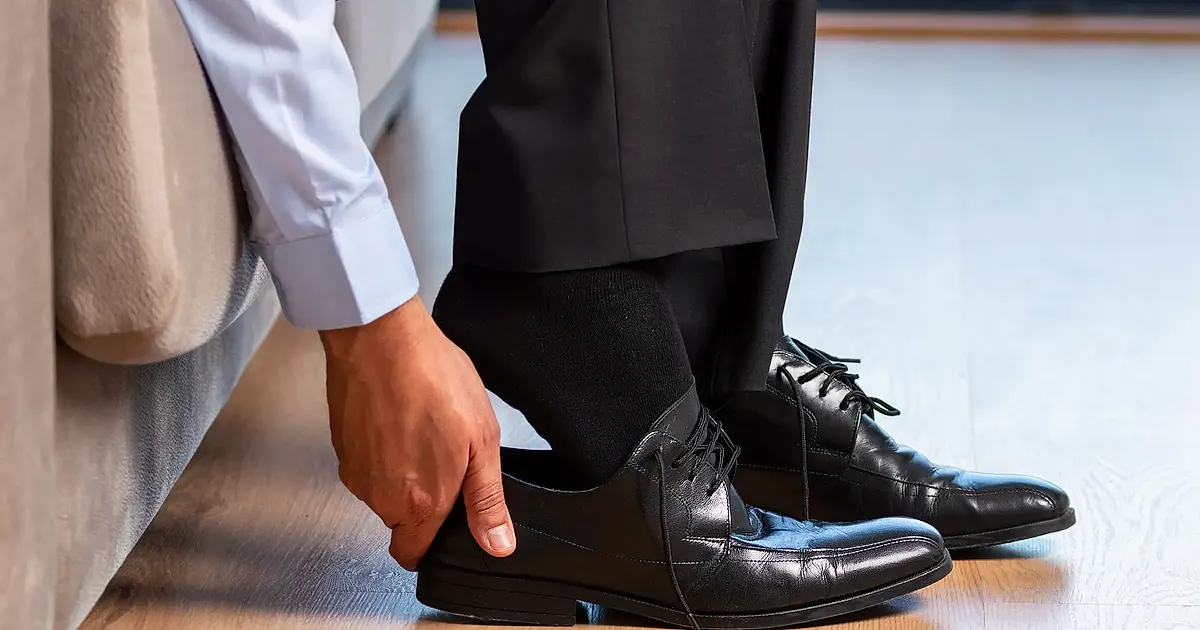
The practical consequence runs backwards into your packing. Lace-up boots turn every doorway into a small negotiation. Slip-ons, sandals, loafers, anything with a heel you can hook a finger into, make a day of six thresholds effortless. Pack socks without holes. You will see them more often than you expect.
Does anyone mind if you get it wrong?
Rarely, and almost never visibly. A foreign visitor who walks two steps into a hall in shoes will usually be met with a hand gesture at ankle height and a smile, which is the whole correction. The embarrassment is entirely yours to feel or not feel.
What people do notice, because it is harder to miss, is the opposite — someone who looks at the floor on their own and stops. It is a small act of attention and it reads clearly. Shoes left tidily, toes outward, so you can step straight into them later. Nobody takes them. In twenty doorways across a trip, nothing will go missing.
If you are uncertain in the moment, copy the person in front of you, or pause at the threshold for half a second. Someone will tell you. In the rare case where no one is around and there is no rack, err toward taking them off; the error costs nothing in that direction.
When this isn't for you
If your trip runs through hotels, international restaurants, museums and historical sites, you may never encounter a threshold that asks anything of you. Museums, citadels, tombs and most temple courtyards are shoes-on throughout. This matters when you are invited somewhere, and only then.
It also genuinely does not work for some travellers. If you have a foot condition, orthotics you cannot remove, or any difficulty balancing while standing on one leg in a doorway, say so plainly — a guide can explain it in a sentence, and it will be accommodated without discussion. Nobody expects pain in exchange for a custom. Carrying a pair of clean indoor socks solves most of the rest. Practical questions of this kind are worth raising before you travel rather than at the door, and our frequently asked questions is a reasonable place to start.
Quick questions
Do I need to take my shoes off at every pagoda?
No — only before entering a worship hall with an altar. Courtyards, corridors and gardens are walked in shoes.
Should I bring slippers with me?
Not necessary. Homes and homestays nearly always offer a pair, and clean socks cover every other situation.
What do I do with the slippers near the bathroom?
Wear them inside the bathroom only, and leave them at its door when you come out. They are not house slippers.