Short answer: Yes, but not in the way the photographs suggest. Most of the households who lived permanently on the water were resettled ashore in the 2010s, and the villages you visit now are working anchorages rather than neighbourhoods. If you want houses full of families, you will be disappointed. If you want to understand how a community lived without land, go.
What happened to the people who lived on the water?
They were moved to the mainland, to a resettlement area built for them in a ward on the edge of Hạ Long city, over the course of a government resettlement programme in the 2010s. Several hundred households were involved. The official reasons were schooling, sanitation, typhoon safety and the condition of the bay's water, and none of those reasons was unreasonable.
Before that, villages like Cửa Vạn and Vung Viêng functioned as addresses. Children were rowed to a floating classroom. A shop raft sold rice, fuel, batteries and fish sauce. A household's wealth was measured in net cages slung beneath the planks, and a family's standing was partly a matter of how long its line had been on the water — some of it going back generations.
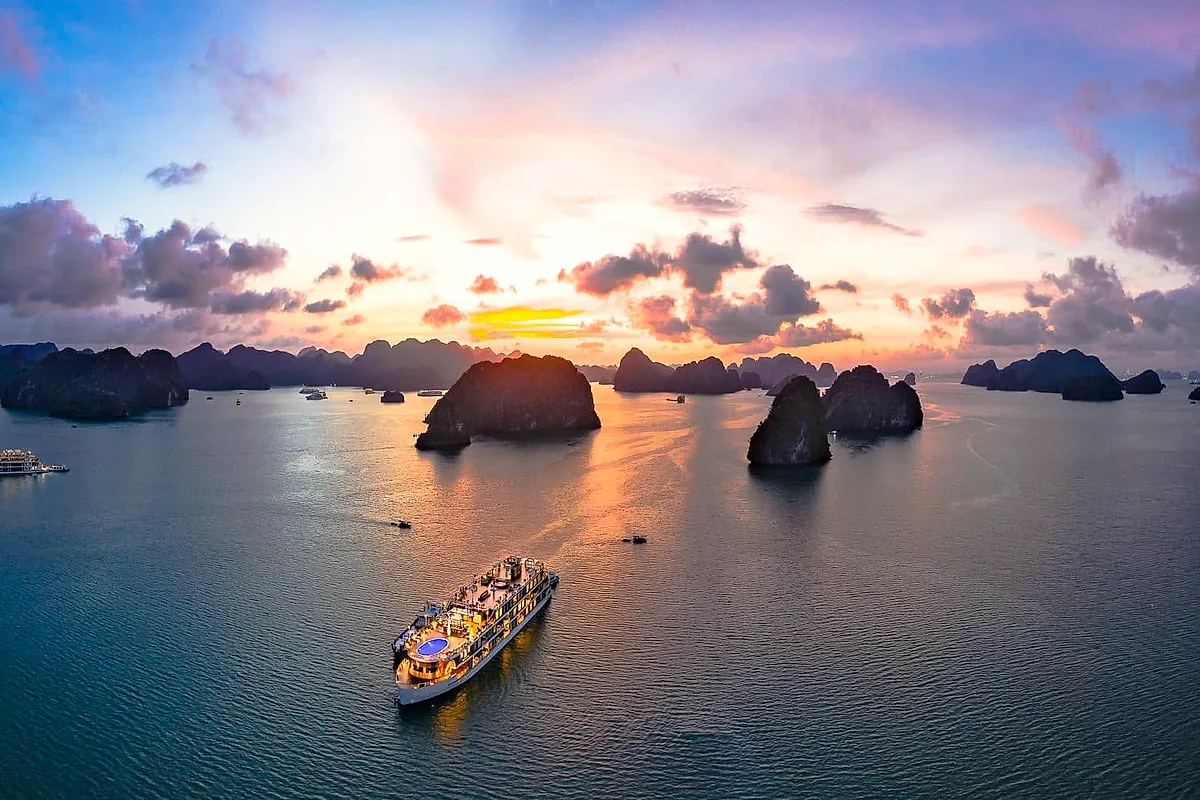
In a storm, the rafts were tied into the lee of a karst wall and the sea arrived as a long, deep swell rather than a breaking wave. The limestone did the work. It is the same geometry that makes the bay so quiet at anchor on an ordinary night.
So what is actually there now?
Rafts, net pens, a few resident caretakers, and the structure of the thing itself. The timber platforms float on blue plastic drums where they once floated on bamboo and sealed jars, and the walkways still flex when two people cross at once. Fish are still raised in the cages. Someone still paints the hulls. Pearl cultivation continues at one or two of the sites, and watching a technician seed an oyster with a nucleus under a bench lamp is a stranger and better fifteen minutes than most things sold as culture.
The rowing boats are the detail worth noticing. They are broad-beamed, low-sided and almost flat on the bottom, built to be stable while someone stands in the stern and works a long oar rather than to be fast. Beneath the boat the cage nets drop five or six metres into green water, and the fish turn under you as the shadow passes.
None of this is theatre, which is also why it can feel underwhelming if you arrive expecting one. A working anchorage on a weekday afternoon is mostly quiet. That quiet is the honest version of the place. For a sense of how deep this kind of settlement runs in these waters, the raft community at Cái Bèo, off Cát Bà, is the other half of the story.
How do you see it properly, and when?
At water level, slowly, and with time either side of it. A floating village visit sits in the suggested plan for the second day of the Hạ Long leg on this private seven-day trip through the north, alongside a second kayaking circuit through different karst channels; like everything on a custom trip, the order can be adjusted. Kayaking is the part that teaches you most about why anyone chose to live here, because you enter the lagoons through low tidal arches that only open at certain states of the tide, and you understand immediately which bays are sheltered and which are not. It is also fully exposed to the sun on the open water between them, so a hat and a long-sleeved layer matter more than they sound like they should.
The year splits cleanly. From October to December the air is dry and the visibility is the best you will get — the karst stacks hold their edges all the way to the horizon. January to March brings low cloud and a fine drizzle; the bay turns soft and grey and genuinely beautiful, but photographs flatten and the water is too cold for swimming. April to early June is warm, clear and the easiest for kayaking and the anchorage swim. From June to September the bay is hot, the light is hard at midday, and tropical storms can suspend sailings at short notice — that is the one real risk to the plan, and it is worth leaving flexibility around the Hạ Long days in those months.
Early morning is the hour that rewards you. Before the day boats arrive, the water is a sheet, and sound carries across it: an outboard two coves away, a dog on a raft, a chain running out.
When this isn't for you
If what you want is a living village photographed from a kayak, skip it and spend the time swimming or on a second cave landing instead. The relocation was real and the rafts are thinner than they were.
Skip it too if you are uneasy about looking at other people's working lives at close range. There is a version of this visit that is simply a boat full of strangers staring at someone's house, and if that sits badly with you, that instinct is correct — go kayaking instead.
And if you are travelling with small children or anyone unsteady on their feet, the walkways and the step down into a rowing boat take real care. They flex, they are wet, and there is nothing to hold.
What stays with most people is not the rafts but the arithmetic behind them: that for generations, a family here measured its ground in net cages and its shelter in the shape of a cliff, and that the bay went quiet when the arithmetic stopped working.
Quick questions
Do people still live on the water in Hạ Long Bay?
A small number of caretakers and fish farmers remain at the working anchorages, but the resident communities were moved ashore in the 2010s.
Which floating village will I see from a Hạ Long cruise?
That depends on the route. Cửa Vạn and Vung Viêng are the two most visited, and cruise itineraries usually include one of them rather than both.
Can I swim in the bay?
Swimming at a secluded anchorage is part of the cruise. It is pleasant from around April through October and cold in the January to March drizzle.