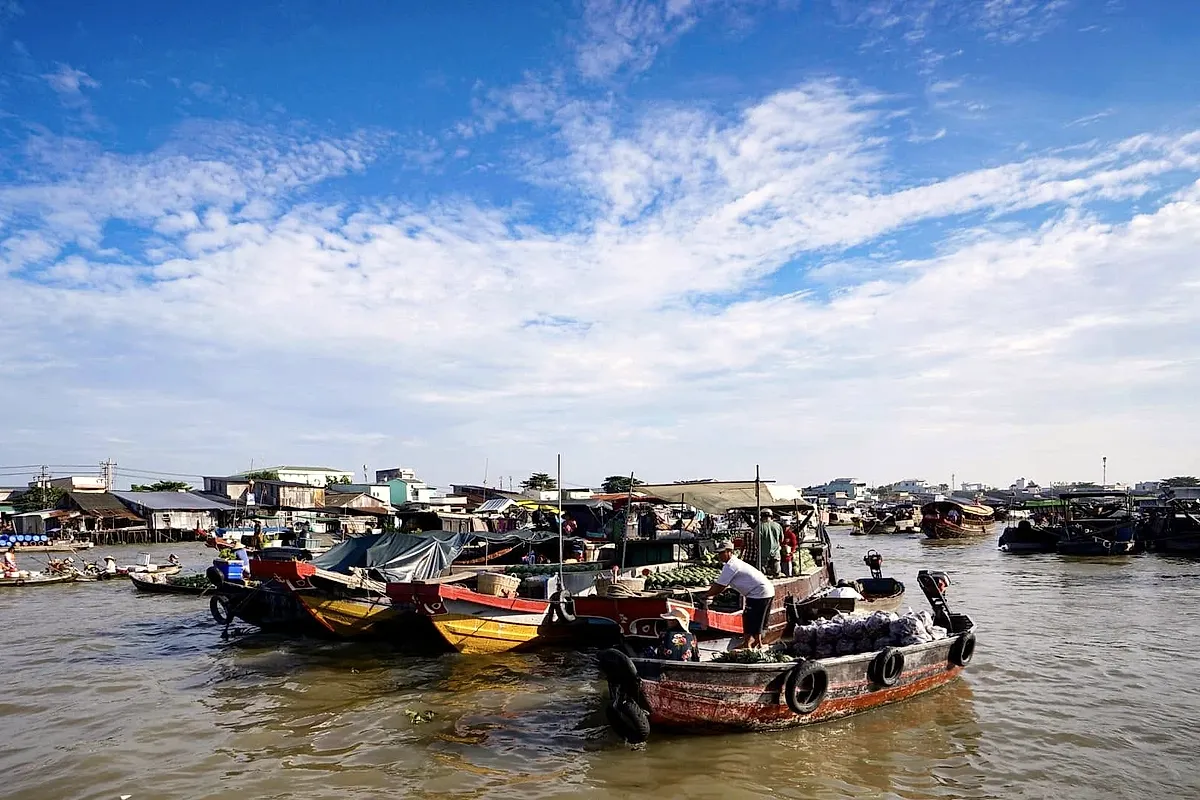
Short answer: Yes, and it is the most ordinary thing happening out there. Small boats work the market selling noodle soup and iced coffee to the traders, and they will sell to you too. It depends on arriving while the wholesalers are still trading — once they cast off, the kitchens go with them.
What is actually cooking on those small boats?
Hot broth, mostly, in a pot set over a burner at the stern of a boat barely wider than a bathtub. The usual bowl is hủ tiếu, a southern rice-noodle soup: clear pork broth, flat noodles or round, sliced pork, often a quail egg, a scatter of fried garlic and herbs added at the last second. There is a second trade running alongside it in iced coffee, condensed milk settled at the bottom of the glass until you stir it, and a third in bánh mì and cut fruit for people who do not want to sit still.
The cook works standing, or half-crouched, with the river doing what rivers do under her. Her hands are the steady part. Ladle, strainer, tongs, a rinse basin of grey water, and a stack of bowls wedged against the hull so they cannot travel. Nothing on the boat is decorative. The burner sits on a tile, the noodles sit in a covered basket, the herbs sit in a plastic tub with the lid off because she reaches into it forty times an hour.
Cái Răng is a wholesale market before it is anything else — produce moves in sack lots from grower to retailer, and at its busiest more than a hundred and fifty boats are gathered on that stretch of the Cần Thơ river. The food boats exist because the people doing the lifting have been awake since two and will not stop to go ashore.
How does a bowl get from one boat to another?
Someone raises a hand, and the kitchen boat comes over and ties on. That is the whole system. The two hulls knock together, a loop of rope goes round a cleat, and for the length of a breakfast the boats are one boat. The bowl is passed across the gunwales at arm's length, held flat, with a spoon and chopsticks already balanced on the rim. Money goes back the same way, usually before the eating is finished, because the kitchen has somewhere else to be.
You eat it on your knees. There is no table. The broth will move in the bowl every time a cargo barge goes past and throws its wake, and the trick everyone on the water knows is to hold the bowl low and let your wrist absorb it rather than your shoulder. Chilli sauce and a wedge of lime come in a small dish you will have nowhere to put. Hold it in the other hand.
When you are done, the bowl goes back across. It is rinsed in river water, wiped, and used again within the minute. This is not a detail anyone hides, and it is worth knowing before you decide.
Why does the hour matter so much?
Because the market is a working window, not an opening time. The trade is heaviest in the dark and the first grey light, thins as the sun gets height, and by mid-morning the wholesale boats have sold what they came to sell and are gone down their own canals. The kitchens follow the customers. Arrive late and you will find the river, the bridge, and a handful of boats selling souvenirs.
There is a second clock underneath the first one. The delta runs on the rise and fall of the water as much as on the hour, and a boat's ability to get in and out of a side canal is set by that, not by a schedule. A private trip south from Saigon into Bến Tre and Cần Thơ works the same way: the suggested plan puts the boat out before dawn on the market morning, and that can shift with the season and the water.
Season matters less here than people expect. From December to April the delta is dry and the mornings are cool and clear. From May to November the afternoons collapse into short heavy rain, but the mornings are usually clear anyway — which is when you are out there. March and April are the hottest, and the difference between six and nine o'clock on the water in April is the difference between a pleasant bench and a sunburn.
When this isn't for you
Skip the eating, not necessarily the market, if you have a sensitive stomach and travel on a tight schedule. Bowls are rinsed in the river. Most people are fine; some are not; you are a long way from a pharmacy at five in the morning. Hot broth from a pot that has been at a rolling boil for hours is the safer end of the spectrum, cut fruit is the riskier end.
Skip the whole thing if a pre-dawn alarm will cost you the rest of the day, or if you are travelling with small children who will be miserable on a hard bench in the dark. And if what you want is an orderly market you can walk through, photograph and leave, this is the wrong river — Cái Răng is commerce between boats, and the only way to be in it is to be on the water with everyone else. Practical questions about timing and the trip generally sit in our frequently asked questions.
The thing that stays with most people is not the market at all. It is a woman cooking standing up, on a moving floor, in the dark, well, and for strangers who will be gone by nine.
Quick questions
How much should I expect to pay for a bowl on the water?
Very little — it is priced for working traders, not visitors. Rates change, so carry small notes and settle the price before the bowl comes across.
Is there a vegetarian option?
Rarely on the kitchen boats, since the broth is pork-based. Fruit sellers and coffee boats are the reliable options, and shore-side Cần Thơ has more choice.
Can I visit Cái Răng without staying overnight in Cần Thơ?
It is difficult. The trade happens before first light, and the drive from Saigon takes most of a morning — by the time you arrived, the market would be over.