At seven in the morning the nipa palms along a Bến Tre side canal carry a dark stain on their stems, a hand's width above the water. That line is a timetable. It marks where the water stood ninety minutes ago, and it tells you the tide is falling, and that the narrow channel we had planned to row is already becoming a trough of grey mud with fiddler crabs working it over.
Nobody in the Delta says they will meet you at eight. They say they will meet you when the water is high — nước lớn — or when it has run out, nước ròng. Two floods and two ebbs cross the lower Delta each day, pushed in from the East Sea and up the nine mouths of the Mekong, and the whole thing shifts roughly fifty minutes later with each turn of the day. A canal that welcomed you at half past six this morning will not do so tomorrow. It will want you at twenty past seven instead.
How to read the water without a table
The easiest sign is the water hyacinth. Lục bình grows in mats across every canal in the south, purple-flowered, rooted to nothing, and it goes wherever the current goes. If the mats are drifting inland, away from the river mouth, the tide is flooding and the small channels are filling. If they are being drawn out towards the main river, you have perhaps an hour before the branch canals start to shoal.
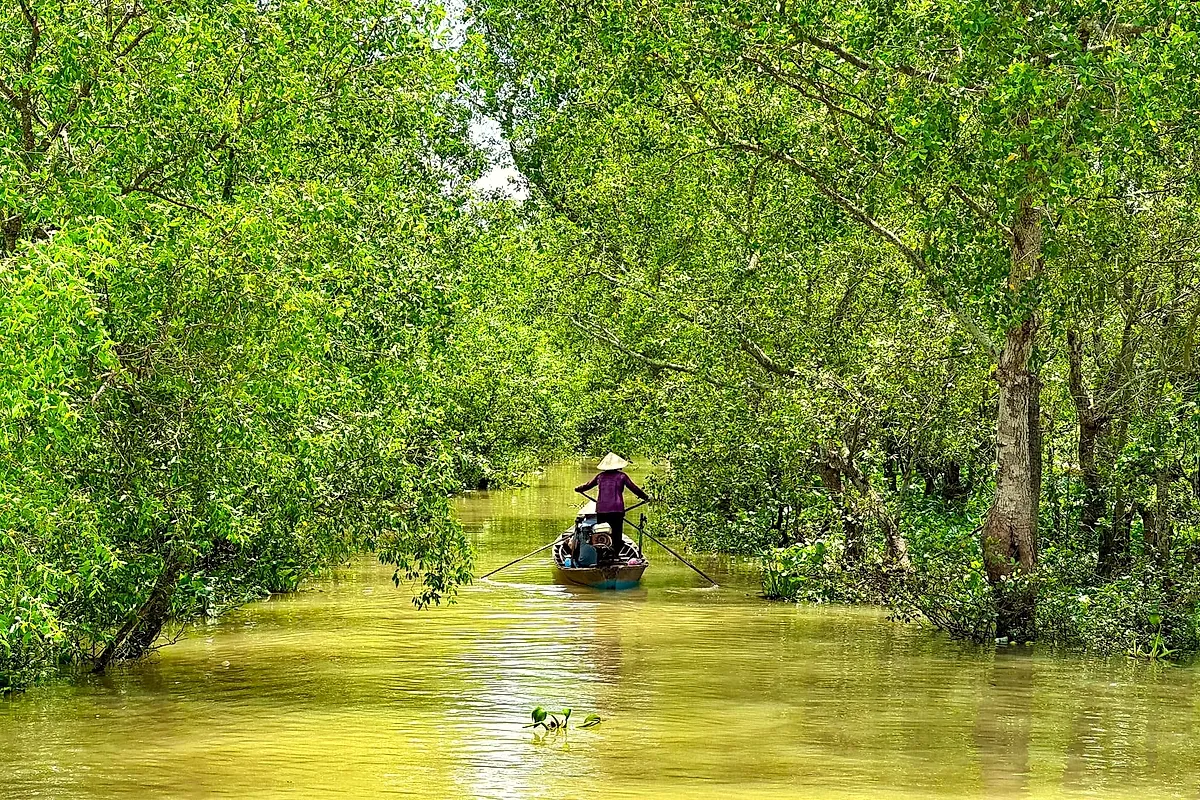
The second sign is the banks themselves. At full flood the water reaches the base of the coconut trunks and the mud is invisible; the canal looks like a lane with green walls. Two hours later the same canal has dropped a metre or more, the mud is exposed, the smell changes entirely — warm, sulphurous, alive — and the rowing becomes work rather than drifting. Mudskippers appear. So do the ladders that householders keep nailed to their landing stages, which are only ladders at low water and are stairs to nowhere at high.
The boats themselves are built to this. A Bến Tre sampan sits shallow enough to cross a bar with a few centimetres to spare, and it is rowed standing, facing forward, with two oars crossed at the chest — a stroke that lets the rower see the bottom coming and lift the blades before they strike. The palm-frond hat and the long gloves are not costume; the sun off the water at nine in the morning is fierce, and the water hyacinth hides everything.
Trade keeps the same rules
Upriver at Cần Thơ, the wholesale market at Cái Răng answers to the same discipline in a different form. The big boats — the ones carrying six or eight tonnes of pineapples, pomelos, sweet potatoes, watermelons — are moored mid-river and they do not move much. The traffic that matters is the small boats coming out to them from the orchards and back again, and those small boats come out of the branch canals, which means they come when the water lets them.
That is why the market is a dawn business and why it thins so sharply. By six the river between the pontoons is crowded — well over a hundred and fifty craft at the peak of the morning, engines idling, poles at the bows advertising what is stacked below. By eight the light has gone hard, the buyers have what they came for, and the sellers want the ebb to carry them home rather than fight it. The market does not close. It simply follows the water out.
There is a version of the visit that involves arriving at nine on a large tour boat to find twenty craft and a lot of tourists photographing each other. The difference between that and the real thing is not luck. It is leaving the pier in the dark.
The season the water turns against you
The tide brings something else in the dry months. From roughly February to April, when the river is low and the sea keeps pushing, salt travels a long way up the branches of the Delta. In the hard dry seasons of 2016 and 2020 it reached far enough inland to kill young rice and stress fruit orchards across several provinces, and households that had never needed to store water were suddenly buying it by the tank.
You can see the response along any canal in Bến Tre: glazed ceramic jars the height of a child, ranked under the eaves, filled during the rains and rationed through the dry. Coconut palms tolerate a good deal of brackishness, which is one reason the province has leaned on them for so long; durian and pomelo do not, and their owners watch the salinity readings the way farmers elsewhere watch a forecast.
None of this reaches you as drama. It reaches you as a boatwoman glancing at a mat of hyacinth, then at her landing stage, and deciding that yes, there is still time to take the narrow cut behind the coconut grove — but only just, and we should go now. Twenty minutes of shade so dense the temperature drops, the sound of the oars, a kingfisher going the other way at speed. Then out into the main channel, into the glare, on a river that has already started to leave.
The Delta will give you that hour. It will not give it to you at a time of your choosing.