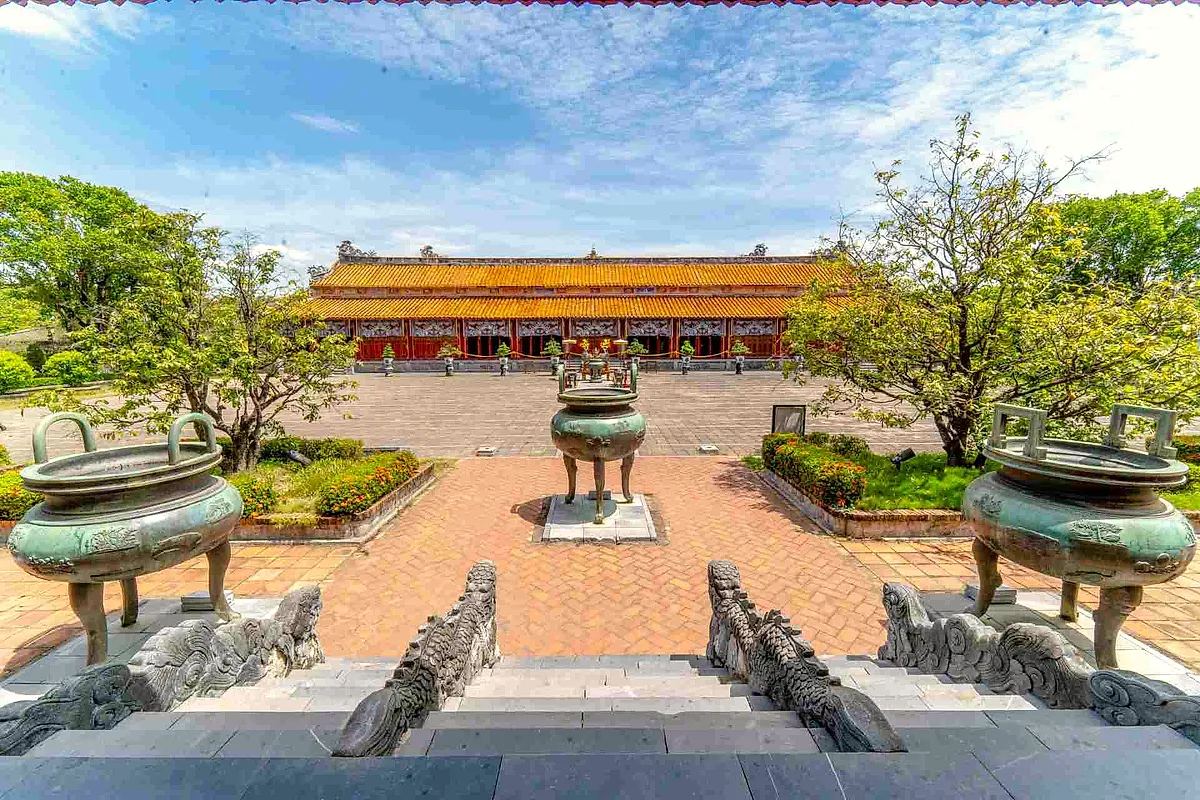
Most people arrive at the Thế Miếu with tired feet. It sits in the south-west quarter of the citadel, past the Nine Holy Cannons, past the long walk from Ngọ Môn, and by the time you reach it the heat has usually won. Which is why the nine bronze vessels in front of the temple are so often walked past — large, dark, standing on low stone plinths in a row, easily mistaken for decorative urns of the kind that stand outside every temple in Asia.
Get close to the third one from the left and you will see a boat under sail. Not a stylised boat. A hull with a rudder, rigging, a sea beneath it, and beside it two characters naming the water it floats on.
The Cửu Đỉnh were cast in Huế between 1835 and 1837 on the order of Minh Mạng, the second Nguyễn emperor, and they have not moved since. Nine urns, one for each of the nine emperors the dynasty planned to honour, each named for a temple name — Cao, Nhân, Chương, Anh, Nghị, Thuần, Tuyên, Dụ, Huyền. The largest, Cao, weighs over two and a half tonnes. What makes them extraordinary is not the size. It is what is on the sides.
An empire, in relief, seventeen panels at a time
Each urn carries its motifs in three tiers, around seventeen or eighteen panels per vessel, roughly a hundred and sixty in total across the nine. They were not chosen for beauty. They were chosen as an inventory.
The sun, the moon, and the five planets on the upper tier. Then mountains, and the rivers that drain them. Then the produce and the machinery of a functioning state: rice, areca, cinnamon, the durian, the elephant, the tiger, the crocodile, a cannon, a matchlock, a sword, a war junk, a river boat. Somebody sat down in the 1830s and decided what a kingdom consists of, and then had it poured in bronze so the answer could not be edited.
The three seas are split across the first three urns. Cao carries the East Sea, Nhân the southern water, Chương the western. Huế's own river, the Hương, appears among them — a court that could see the water from its walls still thought it worth recording on metal. So do the Thuận An estuary, the passes, the mountain ranges that separated the Nguyễn from what they had conquered and what they had not. Read the nine together and you get a claim: this is the extent of us, and these are its contents.
In 2024 UNESCO's regional committee for documentary heritage added the reliefs to its register, which is an unusual designation for a set of objects you can walk up to in the open air, in the rain, unglazed and unlabelled. That is rather the point of them. The Nguyễn did not build an archive and put the country inside it. They put the country outdoors and let it weather.
Where the metal came from, and who still pours it
Cross to the west bank of the Hương, a few kilometres upstream of the citadel, and you reach Phường Đúc — the casting quarter. It has been a bronze-working settlement since the seventeenth century, when the Nguyễn lords brought founders south and settled them close enough to supply the court and far enough that the smoke and the noise stayed out of the palace. The Nine Holy Cannons came from here. So, almost certainly, did the metal skill that made the urns.
It is still a working quarter. The workshops are family concerns, set back off the road behind gates, and on a day when a mould is being poured you hear it before you see anything: the ring of a hammer on a spent clay shell, then the particular silence of people who are watching something that cannot be paused. The furnaces are charcoal and forced air. The moulds are clay and rice husk and ash, built up around a wax or resin model, fired until the model is gone and the cavity holds its shape. The alloy is copper with tin and a little lead. Poured at the wrong temperature it chills in the channel and the piece is scrap.
Standing in a foundry yard for twenty minutes changes what the urns look like afterwards. A hundred and sixty reliefs is not a hundred and sixty carvings. It is a hundred and sixty decisions taken at the model stage, in soft material, knowing there is one attempt. A bad panel means recasting a two-tonne vessel.
The hour to go
The Thế Miếu courtyard faces open sky and the bronze holds heat. Before nine it is still cool, the coach groups are concentrated at Ngọ Môn and the Thái Hòa palace at the front of the citadel, and the light comes in low enough from the east to throw the reliefs into relief — which sounds obvious, and matters more than anything else you can control. At midday the panels flatten out and disappear. By four the surface is too hot to stand beside comfortably.
We usually take the citadel back to front for this reason: the urns and the Thế Miếu first, then the long walk forward through the restoration work and the foundations of the halls that did not survive 1968, arriving at Ngọ Môn as everyone else is leaving it.
Two days later, in Hội An, you will see a Japanese bridge, Chinese assembly halls, and a river that carried the port's trade out to the East Sea. It is worth remembering that the same sea was cast into bronze in Huế, by a court that wanted it written down, two characters and a boat under sail, on a vessel that has stood outdoors in the rain for nearly two centuries.