Short answer: Yes, if you treat it as an hour inside a cave rather than a view from a summit. The ascent is short but the steps are steep and sun-struck, and the reward is underground: chambers of veined stone, incense, and a shaft of daylight through a hole in the roof. In heavy rain, skip it.
What is actually inside Marble Mountain?
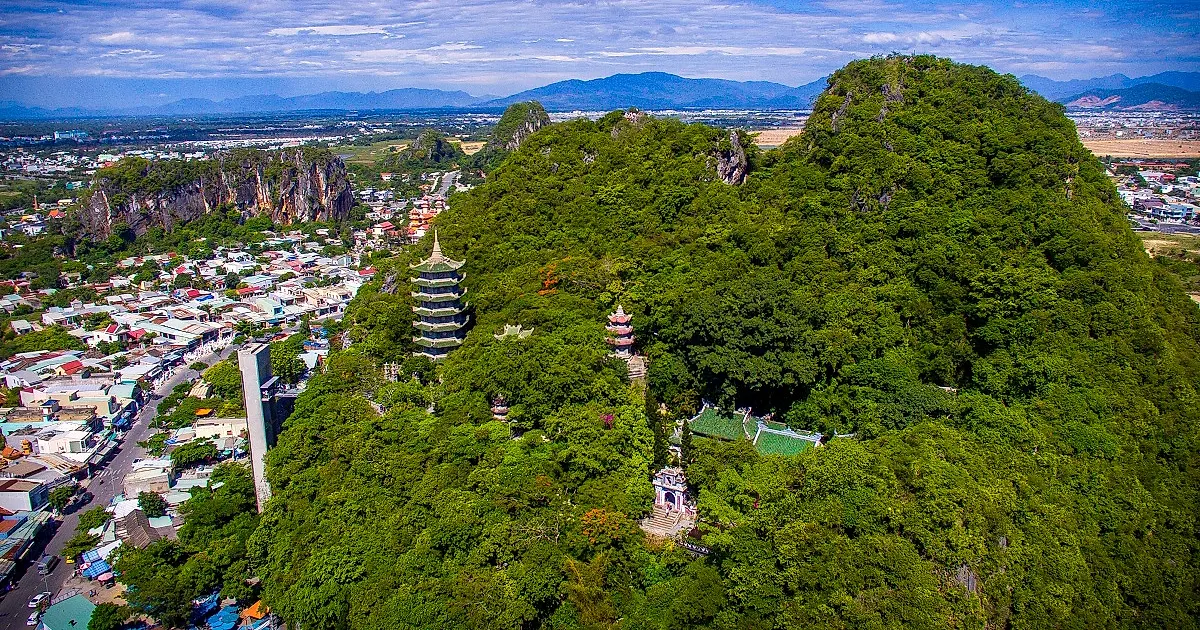
Five limestone and marble outcrops rising straight out of flat sand between Đà Nẵng and Hội An, hollowed by water into chambers that were turned into shrines. They are called Ngũ Hành Sơn, the five elements: Kim, Mộc, Thủy, Hỏa, Thổ — metal, wood, water, fire, earth. Thủy Sơn, the water mountain and the largest, is the one most visitors climb, which is why almost everyone who says Marble Mountain means that one hill.
You climb worn marble steps, polished by decades of feet into a surface that does not forgive wet weather, and the temperature drops the moment you step off the stone staircase into a chamber. Huyền Không is the largest cave. Statues stand in niches cut at shoulder height. The air smells of damp rock and sandalwood smoke,. The cave was used as a field hospital during the war, and the stone still carries the scars of that period.
Outside, the steps bake. Inside, it is noticeably cooler and the light is brown. That contrast, repeated three or four times over an hour, is the real experience of the hill — not the panorama, which is pleasant but is a panorama of rooftops, sand and a flat blue sea.
When does the light fall into Huyền Không?
Around the middle of the day, when the sun is high enough to come through the holes in the cave roof almost vertically. Those openings are natural — the ceiling collapsed at some point and never closed — and for a short window the beams reach the cave floor as distinct columns, picking out whatever incense smoke happens to be hanging in them. Photographs of the cave that appear to be lit by a stage lamp were taken then.
It only works on a clear day. Under the grey ceiling of a November afternoon on the central coast, the cave is still a cave, still cool, still worth the climb, but the shaft is simply not there. This is one of the few places in Vietnam where an eleven o'clock start beats an early one.
On a twelve-day private journey from Hanoi to the Mekong Delta, the suggested plan puts the brief ascent at around 11:00, after the morning transfer over the Hải Vân Pass and before lunch beside the Hàn river in Đà Nẵng, with entrance fees to listed sites included. It can be moved. In the hot months, many travellers prefer the hill earlier and accept softer light in the cave; in the rainy months it is worth keeping flexible and seeing what the sky is doing when you come down off the pass.
Why don't the carvers cut the mountain any more?
Because taking stone out of the hills was stopped decades ago to keep the five outcrops from being quarried away entirely. The village at the foot of Thủy Sơn, Non Nước, has worked marble for centuries, and it still does — but the raw blocks now arrive by truck from elsewhere.
Walk the lane between the workshops and the first thing you register is not sight but sound: angle grinders, a high continuous whine, and under it the slower knock of a chisel. Then the dust, a fine pale film on every leaf of every potted plant for a hundred metres. Men work on life-size Quan Âm figures with the piece lying on its back like a patient. The showrooms sell everything from a thumb-sized turtle to a three-metre Buddha that would need a crane and a shipping agent.
It is not an orchestrated craft demonstration. Nobody stops to explain. If you want to buy, ask whether a piece is local marble or imported stone before you talk about price.
When this isn't for you
If steep steps are a problem, think carefully. There is a lift on one side of Thủy Sơn that handles the main climb, but once you are up there the paths between the caves still involve uneven stone, low lintels and short flights with no alternative route. The lift solves a third of the problem, not all of it.
If it is pouring — and between October and November on this coast it can pour for days — the marble underfoot becomes genuinely slippery and the caves lose their light. Better to spend that morning in Hội An under a roof.
And if you have already decided that what you want from the central coast is beach, tailoring and the old town, you do not need this stop. It is a forty-minute to one-hour detour on a drive you are making anyway. Its value is that it is the only place on that stretch of road where you go inside the geology rather than looking at it from a boat or a pass.
The hills were sacred long before they were a stop between two cities. That is still legible in the small details: the fruit left on a ledge, the fresh incense in a holder at the back of a chamber nobody photographs, the floor swept each morning by someone who lives at the bottom of the steps.
Quick questions
How long do you need at Marble Mountain?
An hour covers the main caves and shrines on Thủy Sơn at an unhurried pace. Add twenty minutes if you want to walk through the carving workshops at Non Nước.
Is it cool inside?
The caves are noticeably cooler than outside, but the staircases and the paths between them are exposed and hot in the middle of the day. Carry water and wear shoes with grip.
Can you combine it with Hội An on the same day?
Easily — it sits between Đà Nẵng and Hội An, so it works as a stop on the drive. Pairing it with a long beach afternoon is less comfortable in the hot months.