In the outer courtyard of Đền Đinh Tiên Hoàng, in front of the gate, there is a bed made of stone. Not a symbolic slab — a bed, waist-high, with a carved frame and legs, dragons worked along the sides with their whiskers curling back over their own shoulders. It is called a long sàng, a dragon couch, and it was cut by seventeenth-century masons for an emperor who had been dead for six hundred years by then. Rain has softened the scales. The stone is the same grey limestone as the cliffs standing directly behind the temple, quarried perhaps a few hundred metres from where it now sits.
Most people walk past it on the way to the incense. It is worth two minutes and a slow circuit, because it explains something about the place that no plaque does: Hoa Lư was never really abandoned. The court left. The masons kept coming back.
A capital chosen for the wrong reasons
In 968, a man named Đinh Bộ Lĩnh finished off the last of twelve rival warlords, declared himself Đinh Tiên Hoàng — first sovereign emperor — and named his country Đại Cồ Việt. He did not build his capital on a river plain where trade would find it. He built it here, in a pocket of flat ground almost entirely enclosed by limestone ridges, and he walled the gaps between the ridges with earth. The mountains did the rest of the work. From above, the site is a room with the door half shut.
The story attached to his childhood is the one every Vietnamese schoolchild knows: a buffalo boy in these fields, marshalling other boys into armies, using reed flowers as banners. Cờ lau, reed flags. Whether or not it happened, it tells you what people wanted their first emperor to be — local, poor, and good at organising.
He was assassinated in his own palace in 979, along with his eldest son. His general Lê Hoàn took the throne the following year and turned back a Song invasion. That temple stands too, a few hundred metres along the same lane, lower and quieter, and the sequence of the two buildings is the sequence of the dynasty: eleven years, then twenty-nine, then it was over.
In 1010, Lý Công Uẩn issued an edict explaining why he was moving the capital north to a bend in the Red River. He was polite about his predecessors and blunt about the geography. Hoa Lư, he wrote, was cramped and low-lying; a dynasty could not grow there. He moved to Đại La and renamed it Thăng Long, the ascending dragon. That city is Hanoi, and it has been the centre of the country more or less ever since.
So the walls that made Hoa Lư safe are the walls that made it temporary. Forty-two years as a capital. The rice went back to being rice.
What is actually there
The two temples you walk through were built in the seventeenth century under the Later Lê, on the footprints of the old palace ground. They are wooden, dark inside, laid out with an outer gate and inner halls in a nested rectangle. Ironwood columns rest on carved stone drums so the damp cannot climb. The incense smoke goes up and hangs in the roof beams, where it has been going for four hundred years, and the timbers are black with it.
Behind the Đinh temple, a stone stairway climbs Mã Yên — Saddle Mountain, named for its shape — to the emperor's tomb. It is not a long climb but it is exposed, and in May the risers hold heat like a stove top. Fifteen minutes up. From the top you see the whole enclosed basin, the ridgelines running around it, and the two temple roofs below looking very small on a floor that once held a palace with gilded pillars, according to the annals, and a courtyard where the emperor is said to have kept a caged tiger and a cauldron for anyone who broke his laws.
Then you come down and there are ducks in the ditch and a woman selling cơm cháy, the scorched rice crust that Ninh Bình sells everywhere, and the eleventh century puts itself away again.
How we time it
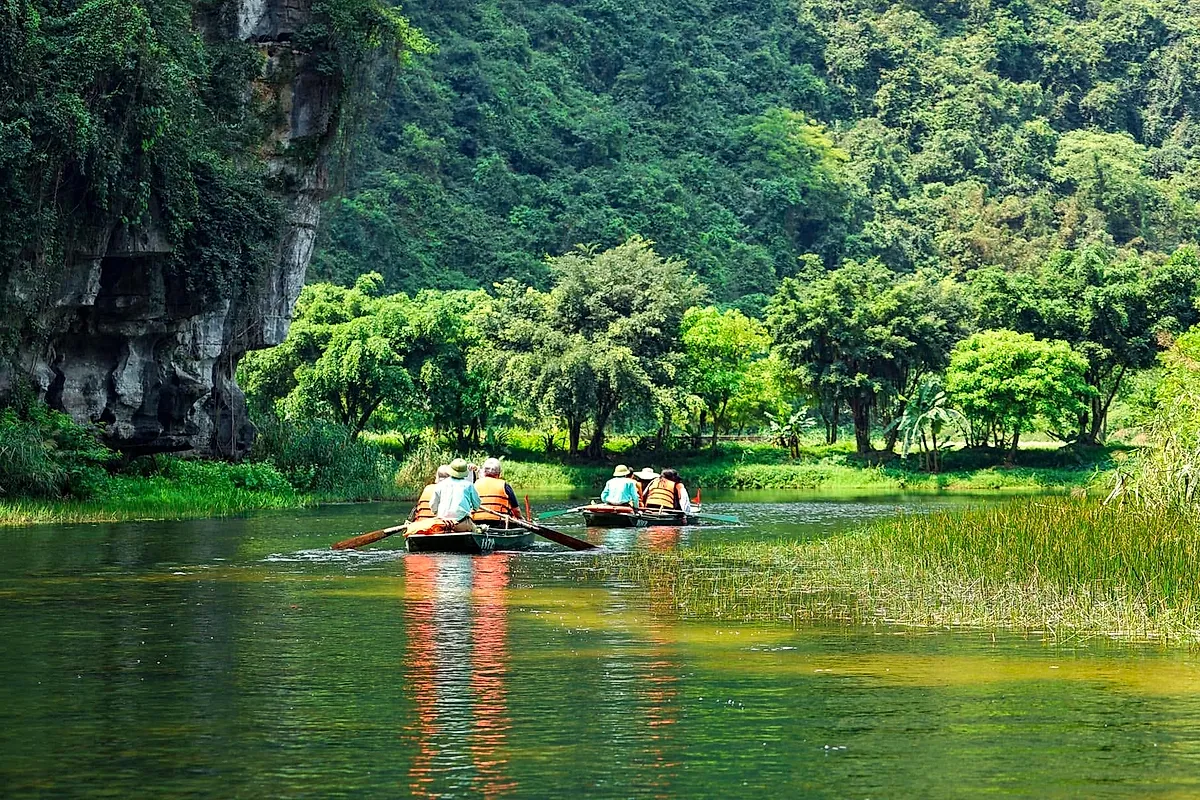
Our guides bring people to Trường Yên at mid-morning, after the first wave of coaches has come and gone and before the second arrives, and we walk the two temples in reverse — Lê Đại Hành first, then Đinh Tiên Hoàng — so that the dragon bed and the mountain come at the end rather than the beginning. It reads better that way. Lunch afterwards is indoors, in shade, in a garden restaurant a short drive on, timed to the heat rather than to a schedule, and the sampan at Tam Cốc waits until the light has come down the cliffs a little.
Once a year, on the eighth to tenth days of the third lunar month, the village holds the Hoa Lư festival: a water procession on the Hoàng Long river, and children carrying reed flags across the field where the buffalo boy is supposed to have drilled his army. Three days. The rest of the year it is a lane, two temples, and a stone bed nobody is allowed to sleep on.