The stele stands under a pavilion at the far end of the grounds, past the lake and the pine walk, where most people have already turned back. It is a slab of blue-grey stone taller than a man and roughly the weight of four elephants. Cut in Thanh Hóa, three hundred kilometres north, and dragged south over four years to reach this hillside outside Huế. When it finally arrived, the emperor Tự Đức had the text carved into it himself — 4,935 characters, the longest inscription of its kind in Vietnam.
Emperors did not write their own epitaphs. A son did that, or a court historian, and the tone was fixed by convention: virtue, mandate, heaven's approval. Tự Đức had no son. Around a hundred consorts, thirty-six years on the throne, and no child to hold the brush. So he took it up.
What he wrote is not what a court historian would have written. He lists his failures. The French taking the southern provinces. The famines. The rebellions. The smallpox that left him frail and childless. He calls his own reign a misfortune to the country and asks, in stone, to be judged honestly. It is the only royal inscription in Vietnam where the subject apologises.
Khiêm, sixty times over
The complex began under another name. Vạn Niên Cơ — Base of Ten Thousand Years — and the conscripted labour that built it worked under conditions bad enough to produce an uprising in 1866, led by masons with their lime-pounding pestles. The revolt failed. The men who led it were executed. Tự Đức renamed the site Khiêm Cung: the Modest Palace.
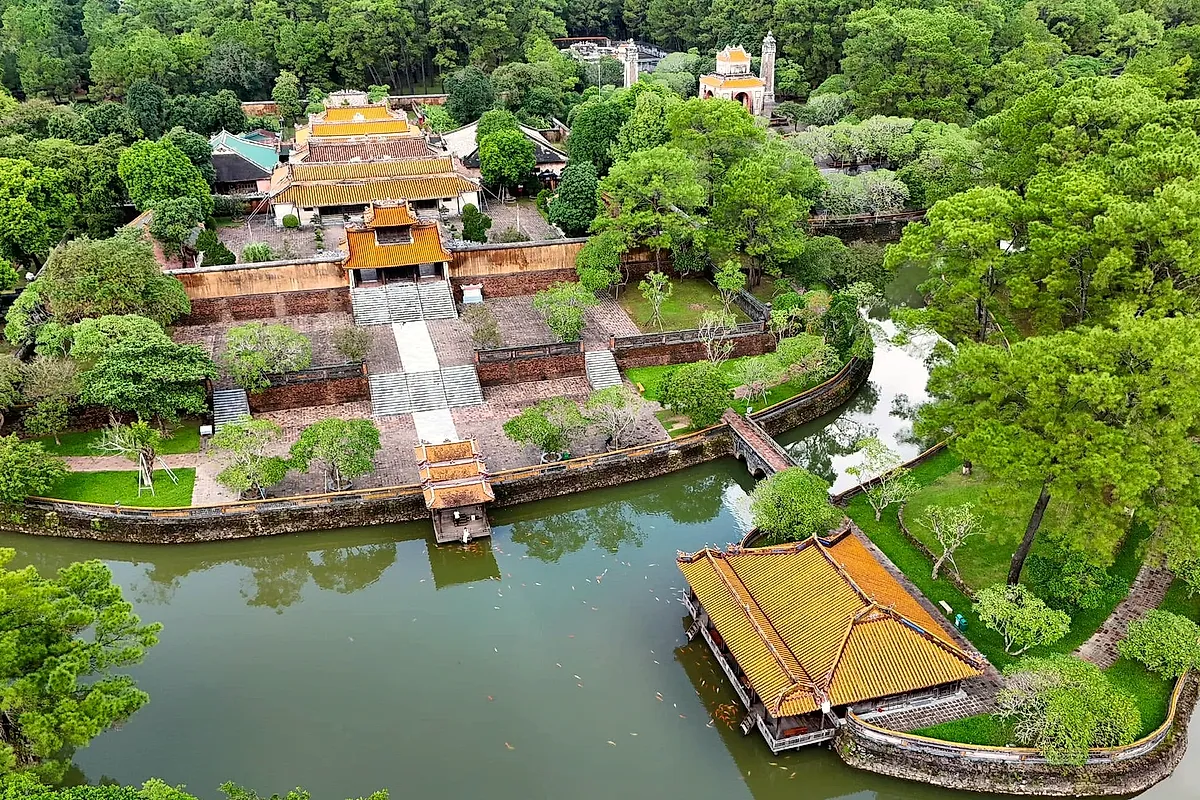
The renaming went further than the gate. Every structure inside the walls carries the character khiêm — modesty. The lake is Lưu Khiêm. The pavilion over the water is Xung Khiêm. The theatre, the gates, the residence, the tomb itself: khiêm, khiêm, khiêm, repeated across fifty-odd buildings like a man saying a word until he believes it. Our guide in Huế points this out at the third or fourth building, and after that you start reading the gateposts yourself.
He lived here while it was being built, and after. Wrote poetry on the pavilion over the lotus lake. Fished. Received ministers in a residence sized for retreat rather than rule. The grounds were a working retirement decades before they became a grave, which is why they feel like a garden that happens to contain a tomb rather than a tomb with landscaping around it.
And then there is the last fact, which our guide tends to leave until you have walked the whole loop. The tomb is empty. Tự Đức was buried somewhere in Huế in secret, and the two hundred servants who carried out the burial were beheaded so that the location would stay unknown. Grave robbers were a genuine concern; the Nguyễn court had watched what happened to earlier dynasties. So the emperor who confessed everything in five thousand characters of public stone lies in an unmarked hole nobody has ever found.
Why the afternoon matters
Huế is the fifth day of a twelve-day route that starts in Hanoi's Old Quarter and ends in a rowboat in a Mekong side canal, and it is the day the register changes. Hanoi is copper on anvils and horns. Hội An, two days later, is lantern silk and a wok. Huế sits between them and is quieter than either — a city that lost its function in 1945 and has been keeping its own counsel since.
The Citadel takes the morning. Most itineraries then push a tomb into the afternoon as a photo stop: twenty minutes, the ornate mosaic interior at Khải Định, back in the vehicle. Khải Định is the more immediately spectacular of the two — French concrete, glass and porcelain shard mosaic, blackened by weather into something that looks a century older than it is. It photographs magnificently. It is also a building that arrived when the throne had already become ceremonial.
Khiêm Lăng gives you less at first glance and more at the second. Pines, a lake choked with lotus in early summer, frangipani over the stone paths, and the courtyard of mandarin statues carved shorter than Tự Đức himself, who stood barely over a metre and a half. Because the vehicle and the guide are yours for the day, the visit is not clipped to a coach's departure. You can stand at the stele long enough for someone who reads the characters to walk you through a paragraph of it, which is the difference between seeing a large stone and understanding what a man put on it.
Go late in the day. The tour buses front-load the tombs after their Citadel morning and are largely gone by four. Light comes low through the pines then, the lake flattens, and the cicadas start. In the rainy months, roughly September through December, the same hour is often grey and dripping and the pines smell of wet resin, which is not worse. Huế in rain is Huế being itself.
The inscription ends with an instruction. Judge me by what I have written, not by what will be said of me. Nobody quotes it. The stone has been standing in the same courtyard since 1875, saying it anyway, to whoever walks the last hundred metres.