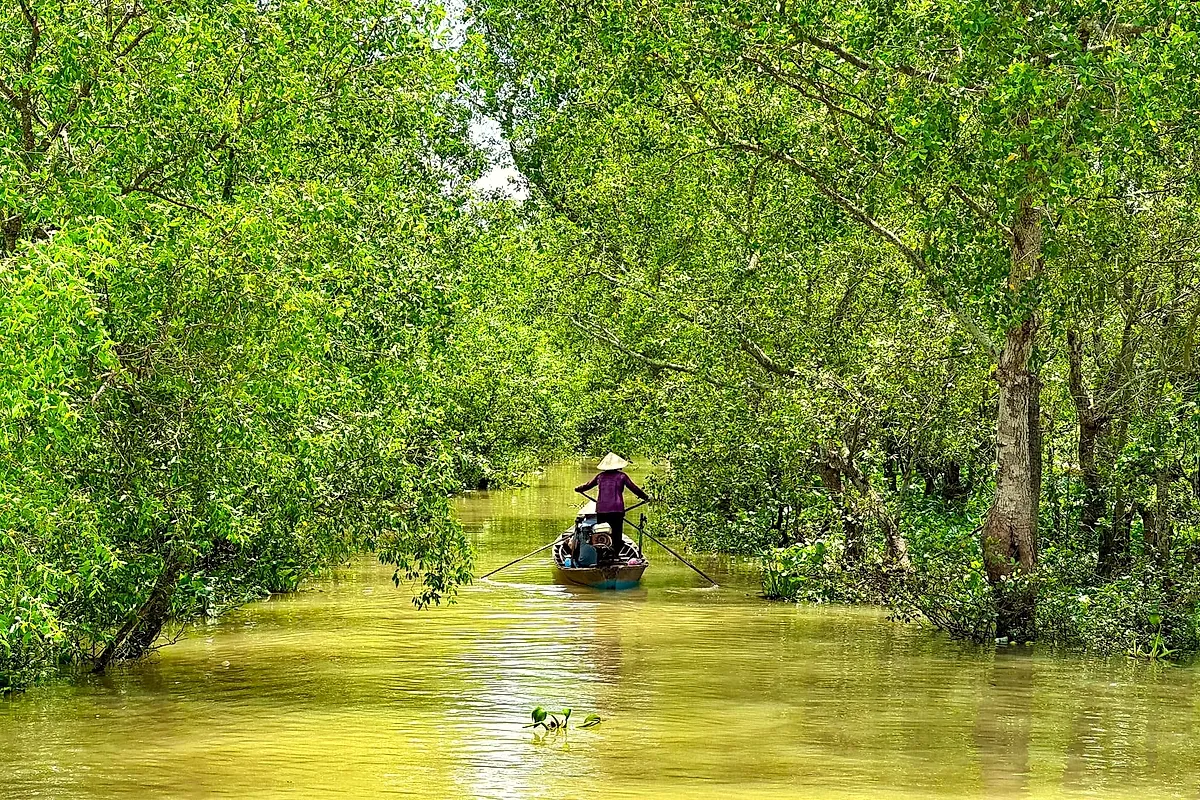
The first thing you notice on the small canals south of the Hàm Luông river is not the palms. It is the smell: a sour, faintly fermented note coming off the water where coconut husks have been left to soak. They sit in the shallows in loose rafts, weighted down with a plank and a brick, softening for weeks until the fibre lets go of the pith. Retting, in English. In Bến Tre it is simply what you do with husks before you beat them.
Bến Tre is three islands — cù lao An Hóa, cù lao Bảo, cù lao Minh — pinned between the distributary mouths of the Mekong, and it has built an entire provincial economy on a fruit that most of the world treats as a drink and a garnish. Ride the small canals for an hour and you can watch a single coconut come apart into four separate trades, none of which meet each other again.
Husk, fibre, rope
Once the husk has softened, it goes through a beating machine that shakes the fibre free of the corky brown pith. The fibre — chỉ xơ dừa — comes out in a hank like coarse hair and gets spun into rope, twisted into mats, packed into grow-bags for orchid nurseries and shipped north and abroad by the container. The pith that falls out underneath is not waste either: dried, it becomes coir peat, the light brown growing medium sold in compressed bricks in garden centres in Rotterdam and Osaka.
The workshops that do this are small, open-sided, roofed in corrugated tin and often built out over the water so the boats can load straight from the floor. There is nothing picturesque about the noise. The beaters clatter, the spinning wheels squeal, and everyone works in a permanent brown haze of dust that settles in the hair and the corners of the eyes. It is worth standing in for ten minutes anyway. You will not think about a doormat the same way afterwards.
What the copper pan does
The flesh goes somewhere else entirely. In Mỏ Cày Nam, the district that everyone in the province will tell you invented the thing properly, mature coconut is grated, pressed and boiled down into kẹo dừa — coconut candy, though candy undersells it.
The pan is copper, wide and shallow, set over a wood fire. Into it go the thick first-press coconut milk, cane sugar and mạch nha, a malt syrup made from sprouted glutinous rice that keeps the finished sweet chewy rather than brittle. Then somebody stirs. Not occasionally — continuously, for the better part of an hour, with a wooden paddle the length of an oar, while the mixture goes from white to cream to a deep caramel and the room fills with a smell somewhere between toffee and toasted rice. Stop stirring and it catches on the bottom, and the whole batch tastes of burn.
When it is ready it goes onto oiled trays to set, gets rolled flat, and is cut into small rectangles with a blade run along a wooden guide. Then the part that surprises people: each piece is wrapped twice. The inner wrapper is a translucent wafer of glutinous rice, edible, thin as a contact lens, which stops the sweet sticking to the outer paper and dissolves on the tongue before you register it was there. The outer layer of printed waxed paper is twisted at both ends by hand. Fast hands. Watch a woman who has been doing this since she was fourteen and the twist takes about a second and a half.
Modern versions come with pandan, durian, peanut or a whole strip of ginger folded into the middle. The plain one, warm, straight off the tray before it has fully set, is better than any of them.
Leaf, shell and the rest
The palms leaning over the canal are frequently not coconut palms at all. Dừa nước, nipa, grows in the brackish stretches with its trunk buried in mud and its fronds thrown up in great arcs. The leaflets are stripped, folded over a length of split bamboo and stitched into roofing panels — lá dừa nước — which are stacked in the sun outside houses in bundles like enormous playing cards. A panel roof lasts a few years and costs almost nothing but labour. The flower stalk of the same plant is tapped for sap.
The hard shell burns hot and clean, so it goes to kilns and comes out as charcoal, some of it processed further into activated carbon for water filters. Old, unproductive trunks are milled into a dark, close-grained timber used for chopsticks, salad bowls and floorboards. The coconut water left after the flesh is pressed is fermented into vinegar or into thạch dừa, the springy jelly that ends up in a glass of chè.
Which leaves the whole green coconut, the one a traveller actually recognises, stacked in pyramids in the bottom of a boat. Those are the ones that go up the river to Cần Thơ and end up at Cái Răng before dawn, sold by the hundred from deck to deck. By the time you are drinking one at six in the morning with the sky still grey over the wholesale boats, you are holding the least interesting part of the plant. Everything else was dealt with sixty kilometres downstream, quietly, before you woke up.