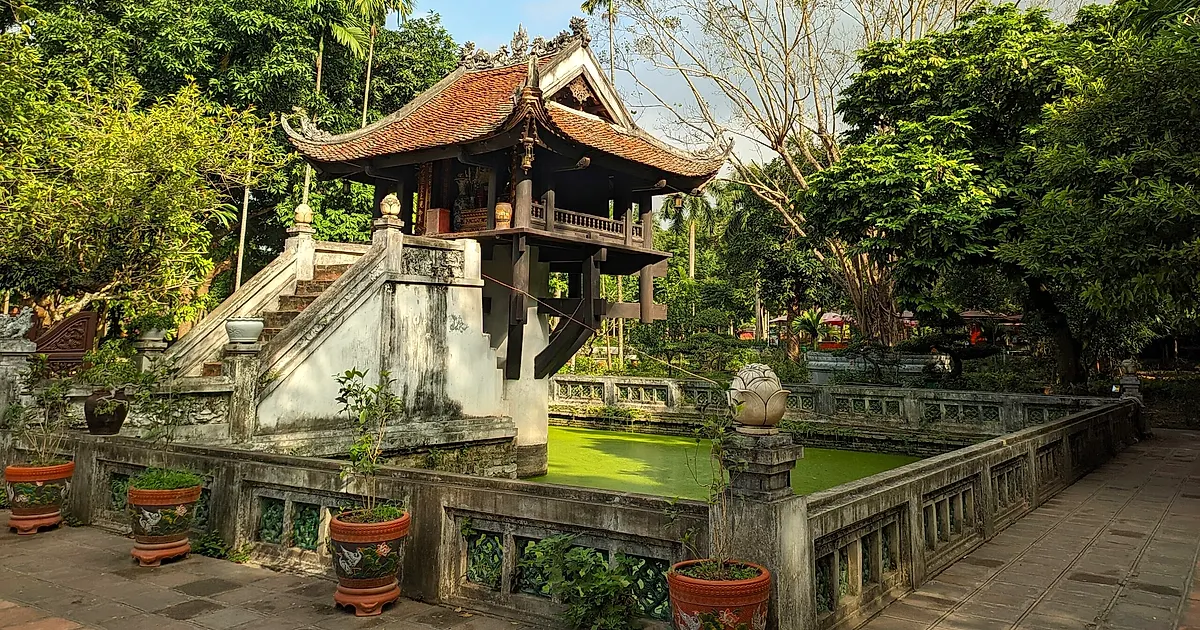
Short answer: Yes, but not as a monument — as a measurement. The pagoda is small, a reconstruction, and takes four minutes to walk around. It earns its place because of what stands beside it: the country's principal ceremonial square. Read the two together and the stop works. Treat it as a photograph and you will be disappointed.
What are you actually looking at?
A single-room wooden shrine, roughly three metres square, raised on one stone column out of a small pond. The roof curls at four corners. A short flight of steps runs up one side. Inside sits Quan Âm, the bodhisattva of compassion, and that is the whole building — no nave, no second chamber, nothing behind.
The formal name is Diên Hựu, which can be read as extended blessing. The story attached to it belongs to the eleventh century and to the emperor Lý Thái Tông, who is said to have dreamed of Quan Âm seated on a lotus and had a shrine built in that shape: a stem rising from water, a flower open at the top. Whether the dream happened matters less than the fact that the design was followed literally. The column is the stem. The building is the bloom.
What stands there now dates from the mid-1950s. The structure was destroyed in 1954, as French forces withdrew from Hanoi, and rebuilt soon afterwards. So the timber is young and the idea is old, which is true of a great deal of Vietnamese architecture and is not the embarrassment foreign visitors sometimes assume.
Why does something this small sit beside Ba Đình Square?
Because it was there first. The pagoda's story belongs to the eleventh century; the square where independence was declared on 2 September 1945 is a twentieth-century space. The pagoda outlasted the changes around it, was destroyed and rebuilt, and ended up a few minutes' walk from a mausoleum of grey stone several storeys high.
Stand with your back to the mausoleum and the contrast does the work. One structure is designed to be approached by tens of thousands of people at once, in columns, in silence. The other was designed to be approached by one person at a time, up a narrow stair, and physically cannot hold more. One is built for a nation's ceremony, the other for a single person's prayer.
There is a practical consequence too. The square has no shade worth the name. The pond around the pagoda has a few mature trees, and the temperature under them is noticeably different from the open ground a short walk away. In the hot months that patch of shade is where everyone ends up, which makes it the most crowded small space in the complex and the least comfortable time to look at anything carefully.
When does it hold up, and when is it just a stop?
Early, and in the cooler half of the year. From October to December the light is clean and low until mid-morning and the open ground does not glare. January to March brings the fine grey drizzle Hanoi calls mưa phùn — the stone darkens, the pond surface goes matte, and the whole complex looks its most serious, though you will want a thin layer. April to early June the heat starts to build and the square becomes an open pan by nine. From June to September, expect humidity that sits on you, sudden afternoon downpours, and a pond that is more interesting than the sky above it.
Opening arrangements at the mausoleum complex are not fixed year to year, and it closes to visitors for maintenance at certain points. That is worth confirming close to your dates rather than trusting a figure printed anywhere. Dress is expected to be modest — shoulders and knees covered — and the guards enforce it without discussion.
On a private full day through Hanoi's neighbourhoods and historic sites, the Ho Chi Minh Mausoleum complex and the One Pillar Pagoda are included as an exterior visit with the entrance fee covered, alongside a licensed English-speaking guide and an air-conditioned vehicle for the transfers. The suggested plan places Ba Đình after the morning's older history — the stone tortoises at Văn Miếu and the colonial prison — and the order can be adjusted. If you are travelling between April and September, there is a strong argument for putting the square earlier than the suggested route does, and letting the indoor and shaded stops take the middle of the day.
When this isn't for you
If your interest in Vietnamese history is pre-colonial and architectural, this stop will frustrate you. The building you came to see is a reconstruction and you cannot go inside it as part of the tour's exterior visit; for original Lý-period stonework you are better served elsewhere in the city. If you dislike security queues, metal detectors and instructions delivered firmly, skip the complex entirely — nothing here rewards a bad mood.
And if you have one day in Hanoi and your priorities are food and street life, Ba Đình is the wrong use of two hours. It is ceremonial ground. It is quiet, formal, and deliberately empty, which is exactly why some travellers find it the most memorable hour of the day and others find it the dullest.
The lotus, as a figure, is about something clean rising out of mud. What is striking is that the smallest building beside the square is the one that has been rebuilt most often — and is always rebuilt the same shape.
Quick questions
Can you go inside the One Pillar Pagoda?
The shrine chamber is tiny and access varies. On this tour the mausoleum complex and pagoda are an exterior visit, with the entrance fee included.
How long do you need at Ba Đình Square?
An hour and a half is comfortable for the square, the pagoda and the surrounding grounds at an unhurried pace. Longer if the queue at the complex is moving slowly.
Is there shade while waiting?
Very little on the open square itself. The trees around the pagoda pond are the exception, and in the hot months everybody knows it.